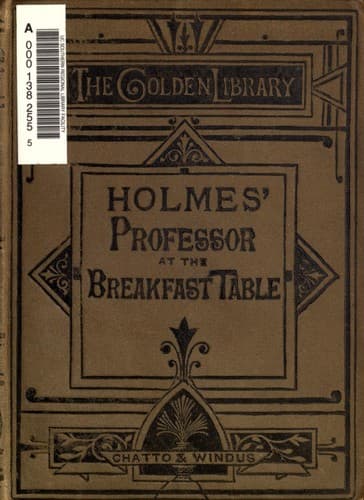
The Professor at the Breakfast-TableHolmes, Oliver Wendell
General
The Professor at the Breakfast-Table
Holmes, Oliver Wendell
American fiction -- 19th century; Conversation -- Fiction; Poetry
More than this; he sees us in a way in which many of our friends or
acquaintances never see us. Without wearing any mask we are conscious
of, we have a special face for each friend. For, in the first place,
each puts a special reflection of himself upon us, on the principle of
assimilation you found referred to in my last record, if you happened
to read that document. And secondly, each of our friends is capable of
seeing just so far, and no farther, into our face, and each sees in it
the particular thing that he looks for. Now the artist, if he is truly
an artist, does not take any one of these special views. Suppose he
should copy you as you appear to the man who wants your name to a
subscription-list, you could hardly expect a friend who entertains you
to recognize the likeness to the smiling face which sheds its radiance
at his board. Even within your own family, I am afraid there is a
face which the rich uncle knows, that is not so familiar to the poor
relation. The artist must take one or the other, or something compounded
of the two, or something different from either. What the daguerreotype
and photograph do is to give the features and one particular look, the
very look which kills all expression, that of self-consciousness. The
artist throws you off your guard, watches you in movement and in repose,
puts your face through its exercises, observes its transitions, and
so gets the whole range of its expression. Out of all this he forms an
ideal portrait, which is not a copy of your exact look at any one time
or to any particular person. Such a portrait cannot be to everybody what
the ungloved call “as nat'ral as life.” Every good picture, therefore,
must be considered wanting in resemblance by many persons.
There is one strange revelation which comes out, as the artist shapes
your features from his outline. It is that you resemble so many
relatives to whom you yourself never had noticed any particular likeness
in your countenance.
He is at work at me now, when I catch some of these resemblances, thus:
There! that is just the look my father used to have sometimes; I never
thought I had a sign of it. The mother's eyebrow and grayish-blue eye,
those I knew I had. But there is a something which recalls a smile that
faded away from my sister's lips--how many years ago! I thought it so
pleasant in her, that I love myself better for having a trace of it.
Public-domain text, read in full here on John Shaqi.
Reviews
Reviews
No reviews yet
Be the first to share your thoughts on this work.
Elsewhere in the archive
Join the Discussion
Join the discussion
Sign in to leave a comment or review.
Sign InorCreate an account