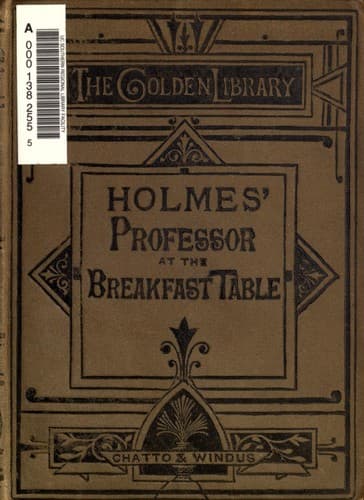
The Professor at the Breakfast-TableHolmes, Oliver Wendell
General
The Professor at the Breakfast-Table
Holmes, Oliver Wendell
American fiction -- 19th century; Conversation -- Fiction; Poetry
--I am satisfied, that, as we grow older, we learn to look upon our
bodies more and more as a temporary possession and less and less as
identified with ourselves. In early years, while the child “feels its
life in every limb,” it lives in the body and for the body to a very
great extent. It ought to be so. There have been many very interesting
children who have shown a wonderful indifference to the things of earth
and an extraordinary development of the spiritual nature. There is a
perfect literature of their biographies, all alike in their essentials;
the same “disinclination to the usual amusements of childhood “;
the same remarkable sensibility; the same docility; the same
conscientiousness; in short, an almost uniform character, marked by
beautiful traits, which we look at with a painful admiration. It will
be found that most of these children are the subjects of some
constitutional unfitness for living, the most frequent of which I need
not mention. They are like the beautiful, blushing, half-grown fruit
that falls before its time because its core is gnawed out. They have
their meaning,--they do not-live in vain,--but they are windfalls. I am
convinced that many healthy children are injured morally by being forced
to read too much about these little meek sufferers and their spiritual
exercises. Here is a boy that loves to run, swim, kick football, turn
somersets, make faces, whittle, fish, tear his clothes, coast, skate,
fire crackers, blow squash “tooters,” cut his name on fences, read about
Robinson Crusoe and Sinbad the Sailor, eat the widest-angled slices of
pie and untold cakes and candies, crack nuts with his back teeth and
bite out the better part of another boy's apple with his front ones,
turn up coppers, “stick” knives, call names, throw stones, knock off
hats, set mousetraps, chalk doorsteps, “cut behind” anything on
wheels or runners, whistle through his teeth, “holler” Fire! on slight
evidence, run after soldiers, patronize an engine-company, or, in his
own words, “blow for tub No. 11,” or whatever it may be;--isn't that
a pretty nice sort of a boy, though he has not got anything the matter
with him that takes the taste of this world out? Now, when you put into
such a hot-blooded, hard-fisted, round-cheeked little rogue's hand a
sad-looking volume or pamphlet, with the portrait of a thin, white-faced
child, whose life is really as much a training for death as the last
month of a condemned criminal's existence, what does he find in common
between his own overflowing and exulting sense of vitality and the
experiences of the doomed offspring of invalid parents? The time comes
when we have learned to understand the music of sorrow, the beauty of
resigned suffering, the holy light that plays over the pillow of those
who die before their time, in humble hope and trust. But it is not
until he has worked his way through the period of honest hearty animal
existence, which every robust child should make the most of,--not until
Public-domain text, read in full here on John Shaqi.
Reviews
Reviews
No reviews yet
Be the first to share your thoughts on this work.
Elsewhere in the archive
Join the Discussion
Join the discussion
Sign in to leave a comment or review.
Sign InorCreate an account