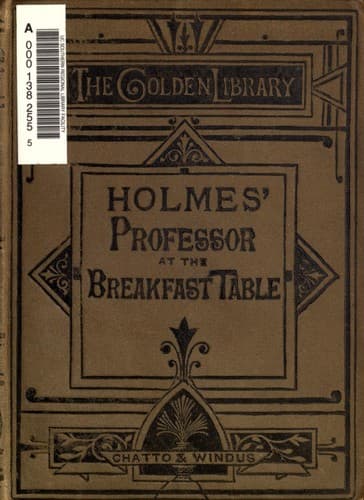
The Professor at the Breakfast-TableHolmes, Oliver Wendell
General
The Professor at the Breakfast-Table
Holmes, Oliver Wendell
American fiction -- 19th century; Conversation -- Fiction; Poetry
Are we not young? Are we not fresh and blooming? Wait, a bit. The artist
takes a mean little brush and draws three fine lines, diverging
outwards from the eye over the temple. Five years.--The artist draws
one tolerably distinct and two faint lines, perpendicularly between the
eyebrows. Ten years.--The artist breaks up the contours round the mouth,
so that they look a little as a hat does that has been sat upon and
recovered itself, ready, as one would say, to crumple up again in the
same creases, on smiling or other change of feature.--Hold on! Stop
that! Give a young fellow a chance! Are we not whole years short of that
interesting period of life when Mr. Balzac says that a man, etc., etc.,
etc.?
There now! That is ourself, as we look after finishing an article,
getting a three-mile pull with the ten-foot sculls, redressing the
wrongs of the toilet, and standing with the light of hope in our eye
and the reflection of a red curtain on our cheek. Is he not a POET that
painted us?
“Blest be the art that can immortalize!”
COWPER.
--Young folks look on a face as a unit; children who go to school with
any given little John Smith see in his name a distinctive appellation,
and in his features as special and definite an expression of his sole
individuality as if he were the first created of his race: As soon as
we are old enough to get the range of three or four generations well in
hand, and to take in large family histories, we never see an individual
in a face of any stock we know, but a mosaic copy of a pattern, with
fragmentary tints from this and that ancestor. The analysis of a face
into its ancestral elements requires that it should be examined in the
very earliest infancy, before it has lost that ancient and solemn look
it brings with it out of the past eternity; and again in that brief
space when Life, the mighty sculptor, has done his work, and Death, his
silent servant, lifts the veil and lets us look at the marble lines he
has wrought so faithfully; and lastly, while a painter who can seize all
the traits of a countenance is building it up, feature after feature,
from the slight outline to the finished portrait.
Public-domain text, read in full here on John Shaqi.
Reviews
Reviews
No reviews yet
Be the first to share your thoughts on this work.
Elsewhere in the archive
Join the Discussion
Join the discussion
Sign in to leave a comment or review.
Sign InorCreate an account