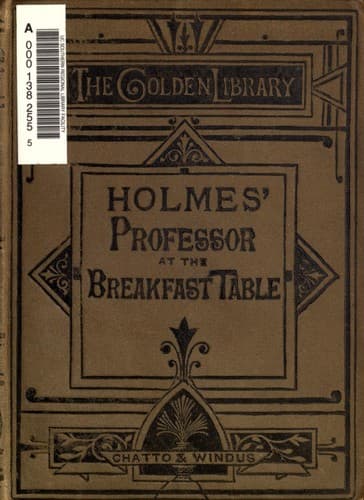
The Professor at the Breakfast-TableHolmes, Oliver Wendell
General
The Professor at the Breakfast-Table
Holmes, Oliver Wendell
American fiction -- 19th century; Conversation -- Fiction; Poetry
a few drops of water on her forehead. She started and looked round.--I
have been in a dream,--she said;--I feel as if all my strength were in
this arm;--give me your hand!--She took my right hand in her left, which
looked soft and white enough, but--Good Heaven! I believe she will crack
my bones! All the nervous power in her body must have flashed through
those muscles; as when a crazy lady snaps her iron window-bars,--she who
could hardly glove herself when in her common health. Iris turned pale,
and the tears came to her eyes;--she saw she had given pain. Then she
trembled, and might have fallen but for me;--the poor little soul had
been in one of those trances that belong to the spiritual pathology of
higher natures, mostly those of women.
To come back to this wondrous book of Iris. Two pages faced each other
which I took for symbolical expressions of two states of mind. On the
left hand, a bright blue sky washed over the page, specked with a single
bird. No trace of earth, but still the winged creature seemed to be
soaring upward and upward. Facing it, one of those black dungeons such
as Piranesi alone of all men has pictured. I am sure she must have
seen those awful prisons of his, out of which the Opium-Eater got
his nightmare vision, described by another as “cemeteries of departed
greatness, where monstrous and forbidden things are crawling and twining
their slimy convolutions among mouldering bones, broken sculpture, and
mutilated inscriptions.” Such a black dungeon faced the page that held
the blue sky and the single bird; at the bottom of it something was
coiled,--what, and whether meant for dead or alive, my eyes could not
make out.
I told you the young girl's soul was in this book. As I turned over the
last leaves I could not help starting. There were all sorts of faces
among the arabesques which laughed and scowled in the borders that ran
round the pages. They had mostly the outline of childish or womanly or
manly beauty, without very distinct individuality. But at last it seemed
to me that some of them were taking on a look not wholly unfamiliar to
me; there were features that did not seem new.--Can it be so? Was there
ever such innocence in a creature so full of life? She tells her heart's
secrets as a three-years-old child betrays itself without need of being
questioned! This was no common miss, such as are turned out in
scores from the young-lady-factories, with parchments warranting them
accomplished and virtuous,--in case anybody should question the fact. I
began to understand her;--and what is so charming as to read the secret
of a real femme incomprise?--for such there are, though they are not the
ones who think themselves uncomprehended women.
Public-domain text, read in full here on John Shaqi.
Reviews
Reviews
No reviews yet
Be the first to share your thoughts on this work.
Elsewhere in the archive
Join the Discussion
Join the discussion
Sign in to leave a comment or review.
Sign InorCreate an account