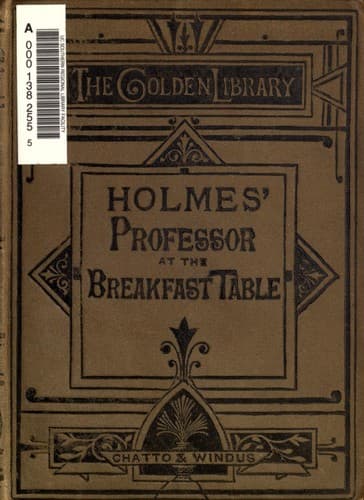
The Professor at the Breakfast-TableHolmes, Oliver Wendell
General
The Professor at the Breakfast-Table
Holmes, Oliver Wendell
American fiction -- 19th century; Conversation -- Fiction; Poetry
Poets are never young, in one sense. Their delicate ear hears the
far-off whispers of eternity, which coarser souls must travel towards
for scores of years before their dull sense is touched by them.
A moment's insight is sometimes worth a life's experience. I have
frequently seen children, long exercised by pain and exhaustion, whose
features had a strange look of advanced age. Too often one meets such in
our charitable institutions. Their faces are saddened and wrinkled, as
if their few summers were threescore years and ten.
And so, many youthful poets have written as if their hearts were old
before their time; their pensive morning twilight has been as cool
and saddening as that of evening in more common lives. The profound
melancholy of those lines of Shelley,
“I could lie down like a tired child
And weep away the life of care
Which I have borne and yet must bear.”
came from a heart, as he says, “too soon grown old,”--at twenty-six
years, as dull people count time, even when they talk of poets.
I know enough to be prepared for an exceptional nature,--only this gift
of the hand in rendering every thought in form and color, as well as
in words, gives a richness to this young girl's alphabet of feeling and
imagery that takes me by surprise. And then besides, and most of all, I
am puzzled at her sudden and seemingly easy confidence in me. Perhaps
I owe it to my--Well, no matter! How one must love the editor who first
calls him the venerable So-and-So!
--I locked the book and sighed as I laid it down. The world is always
ready to receive talent with open arms. Very often it does not know what
to do with genius. Talent is a docile creature. It bows its head meekly
while the world slips the collar over it. It backs into the shafts like
a lamb. It draws its load cheerfully, and is patient of the bit and of
the whip. But genius is always impatient of its harness; its wild blood
makes it hard to train.
Talent seems, at first, in one sense, higher than genius,--namely, that
it is more uniformly and absolutely submitted to the will, and therefore
more distinctly human in its character. Genius, on the other hand, is
much more like those instincts which govern the admirable movements of
the lower creatures, and therefore seems to have something of the
lower or animal character. A goose flies by a chart which the Royal
Geographical Society could not mend. A poet, like the goose, sails
without visible landmarks to unexplored regions of truth, which
philosophy has yet to lay down on its atlas. The philosopher gets his
track by observation; the poet trusts to his inner sense, and makes the
straighter and swifter line.
Public-domain text, read in full here on John Shaqi.
Reviews
Reviews
No reviews yet
Be the first to share your thoughts on this work.
Elsewhere in the archive
Join the Discussion
Join the discussion
Sign in to leave a comment or review.
Sign InorCreate an account