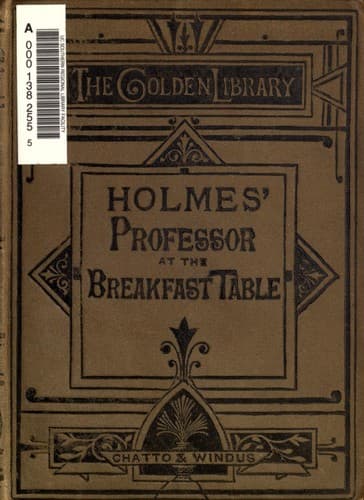
The Professor at the Breakfast-TableHolmes, Oliver Wendell
General
The Professor at the Breakfast-Table
Holmes, Oliver Wendell
American fiction -- 19th century; Conversation -- Fiction; Poetry
I would transport this child to Rome at once, if I had my will. She
should ripen under an Italian sun. She should walk under the frescoed
vaults of palaces, until her colors deepened to those of Venetian
beauties, and her forms were perfected into rivalry with the Greek
marbles, and the east wind was out of her soil. Has she not exhausted
this lean soil of the elements her growing nature requires?
I do not know. The magnolia grows and comes into full flower on Cape
Ann, many degrees out of its proper region. I was riding once along that
delicious road between the hills and the sea, when we passed a thicket
where there seemed to be a chance of finding it. In five minutes I had
fallen on the trees in full blossom, and filled my arms with the sweet,
resplendent flowers. I could not believe I was in our cold, northern
Essex, which, in the dreary season when I pass its slate-colored,
unpainted farm-houses, and huge, square, windy, 'squire-built
“mansions,” looks as brown and unvegetating as an old rug with its
patterns all trodden out and the colored fringe worn from all its
border.
If the magnolia can bloom in northern New England, why should not a poet
or a painter come to his full growth here just as well? Yes, but if
the gorgeous tree-flower is rare, and only as if by a freak of Nature
springs up in a single spot among the beeches and alders, is there not
as much reason to think the perfumed flower of imaginative genius will
find it hard to be born and harder to spread its leaves in the clear,
cold atmosphere of our ultra-temperate zone of humanity?
Take the poet. On the one hand, I believe that a person with the
poetical faculty finds material everywhere. The grandest objects of
sense and thought are common to all climates and civilizations. The sky,
the woods, the waters, the storms, life, death love, the hope and vision
of eternity,--these are images that write themselves in poetry in every
soul which has anything of the divine gift.
On the other hand, there is such a thing as a lean, impoverished life,
in distinction from a rich and suggestive one. Which our common New
England life might be considered, I will not decide. But there are some
things I think the poet misses in our western Eden. I trust it is not
unpatriotic to mention them in this point of view as they come before us
in so many other aspects.
Public-domain text, read in full here on John Shaqi.
Reviews
Reviews
No reviews yet
Be the first to share your thoughts on this work.
Elsewhere in the archive
Join the Discussion
Join the discussion
Sign in to leave a comment or review.
Sign InorCreate an account