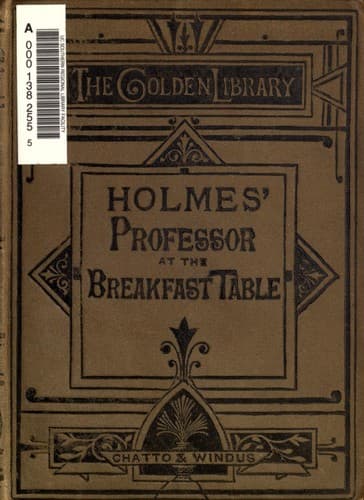
The Professor at the Breakfast-TableHolmes, Oliver Wendell
General
The Professor at the Breakfast-Table
Holmes, Oliver Wendell
American fiction -- 19th century; Conversation -- Fiction; Poetry
There is no sufficient flavor of humanity in the soil out of which we
grow. At Cantabridge, near the sea, I have once or twice picked up an
Indian arrowhead in a fresh furrow. At Canoe Meadow, in the Berkshire
Mountains, I have found Indian arrowheads. So everywhere Indian
arrowheads. Whether a hundred or a thousand years old, who knows?
who cares? There is no history to the red race,--there is hardly an
individual in it;--a few instincts on legs and holding a tomahawk--there
is the Indian of all time. The story of one red ant is the story of all
red ants. So, the poet, in trying to wing his way back through the life
that has kindled, flitted, and faded along our watercourses and on our
southern hillsides for unknown generations, finds nothing to breathe or
fly in; he meets
“A vast vacuity! all unawares,
Fluttering his pennons vain, plumb down he drops
Ten thousand fathom deep.”
But think of the Old World,--that part of it which is the seat of
ancient civilization! The stakes of the Britons' stockades are still
standing in the bed of the Thames. The ploughman turns up an old Saxon's
bones, and beneath them is a tessellated pavement of the time of
the Caesars. In Italy, the works of mediaeval Art seem to be of
yesterday,--Rome, under her kings, is but an intruding newcomer, as
we contemplate her in the shadow of the Cyclopean walls of Fiesole or
Volterra. It makes a man human to live on these old humanized soils.
He cannot help marching in step with his kind in the rear of such a
procession. They say a dead man's hand cures swellings, if laid on them.
There is nothing like the dead cold hand of the Past to take down our
tumid egotism and lead us into the solemn flow of the life of our race.
Rousseau came out of one of his sad self-torturing fits, as he cast his
eye on the arches of the old Roman aqueduct, the Pont du Gard.
I am far from denying that there is an attraction in a thriving railroad
village. The new “depot,” the smartly-painted pine houses, the spacious
brick hotel, the white meeting-house, and the row of youthful and leggy
trees before it, are exhilarating. They speak of progress, and the time
when there shall be a city, with a His Honor the Mayor, in the place of
their trim but transient architectural growths. Pardon me, if I prefer
the pyramids. They seem to me crystals formed from a stronger solution
of humanity than the steeple of the new meeting-house. I may be wrong,
but the Tiber has a voice for me, as it whispers to the piers of the
Pons Alius, even more full of meaning than my well-beloved Charles
eddying round the piles of West Boston Bridge.
Then, again, we Yankees are a kind of gypsies,--a mechanical and
migratory race. A poet wants a home. He can dispense with an apple-parer
and a reaping-machine. I feel this more for others than for myself, for
the home of my birth and childhood has been as yet exempted from the
change which has invaded almost everything around it.
Public-domain text, read in full here on John Shaqi.
Reviews
Reviews
No reviews yet
Be the first to share your thoughts on this work.
Elsewhere in the archive
Join the Discussion
Join the discussion
Sign in to leave a comment or review.
Sign InorCreate an account