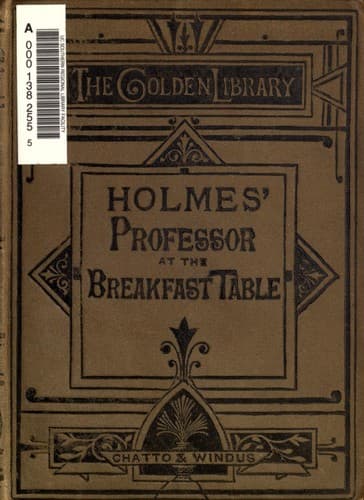
The Professor at the Breakfast-TableHolmes, Oliver Wendell
General
The Professor at the Breakfast-Table
Holmes, Oliver Wendell
American fiction -- 19th century; Conversation -- Fiction; Poetry
She and I,--he said, as he looked steadfastly at the canvas,--she and I
are the last of 'em.--She will stay, and I shall go. They never painted
me,--except when the boys used to make pictures of me with chalk on the
board-fences. They said the doctors would want my skeleton when I was
dead.--You are my friend, if you are a doctor,--a'n't you?
I just gave him my hand. I had not the heart to speak.
I want to lie still,--he said,--after I am put to bed upon the hill
yonder. Can't you have a great stone laid over me, as they did over the
first settlers in the old burying-ground at Dorchester, so as to keep
the wolves from digging them up? I never slept easy over the sod;--I
should like to lie quiet under it. And besides,--he said, in a kind of
scared whisper,--I don't want to have my bones stared at, as my body has
been. I don't doubt I was a remarkable case; but, for God's sake, oh,
for God's sake, don't let 'em make a show of the cage I have been shut
up in and looked through the bars of for so many years.
I have heard it said that the art of healing makes men hard-hearted and
indifferent to human suffering. I am willing to own that there is
often a professional hardness in surgeons, just as there is in
theologians,--only much less in degree than in these last. It does not
commonly improve the sympathies of a man to be in the habit of thrusting
knives into his fellow-creatures and burning them with red-hot irons,
any more than it improves them to hold the blinding-white cantery of
Gehenna by its cool handle and score and crisp young souls with it
until they are scorched into the belief of--Transubstantiation or the
Immaculate Conception. And, to say the plain truth, I think there are
a good many coarse people in both callings. A delicate nature will
not commonly choose a pursuit which implies the habitual infliction of
suffering, so readily as some gentler office. Yet, while I am writing
this paragraph, there passes by my window, on his daily errand of duty,
not seeing me, though I catch a glimpse of his manly features through
the oval glass of his chaise, as he drives by, a surgeon of skill and
standing, so friendly, so modest, so tenderhearted in all his ways,
that, if he had not approved himself at once adroit and firm, one would
have said he was of too kindly a mould to be the minister of pain, even
if he were saving pain.
You may be sure that some men, even among those who have chosen the task
of pruning their fellow-creatures, grow more and more thoughtful and
truly compassionate in the midst of their cruel experience. They become
less nervous, but more sympathetic. They have a truer sensibility for
others' pain, the more they study pain and disease in the light of
science. I have said this without claiming any special growth in
humanity for myself, though I do hope I grow tenderer in my feelings
as I grow older. At any rate, this was not a time in which professional
habits could keep down certain instincts of older date than these.
Public-domain text, read in full here on John Shaqi.
Reviews
Reviews
No reviews yet
Be the first to share your thoughts on this work.
Elsewhere in the archive
Join the Discussion
Join the discussion
Sign in to leave a comment or review.
Sign InorCreate an account