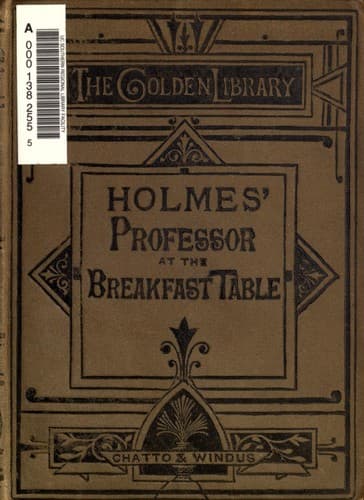
The Professor at the Breakfast-TableHolmes, Oliver Wendell
General
The Professor at the Breakfast-Table
Holmes, Oliver Wendell
American fiction -- 19th century; Conversation -- Fiction; Poetry
Here am I, the Professor,--a man who has lived long enough to have
plucked the flowers of life and come to the berries,--which are not
always sad-colored, but sometimes golden-hued as the crocus of April, or
rosy-cheeked as the damask of June; a man who staggered against books as
a baby, and will totter against them, if he lives to decrepitude; with
a brain full of tingling thoughts, such as they are, as a limb which
we call “asleep,” because it is so particularly awake, is of pricking
points; presenting a key-board of nerve-pulps, not as yet tanned or
ossified, to finger-touch of all outward agencies; knowing nothing of
the filmy threads of this web of life in which we insects buzz awhile,
waiting for the gray old spider to come along; contented enough with
daily realities, but twirling on his finger the key of a private Bedlam
of ideals; in knowledge feeding with the fox oftener than with the
stork,--loving better the breadth of a fertilizing inundation than
the depth of narrow artesian well; finding nothing too small for his
contemplation in the markings of the grammatophora subtilissima, and
nothing too large in the movement of the solar system towards the star
Lambda of the constellation Hercules;--and the question is, whether
there is anything left for me, the Professor, to suck out of creation,
after my lively friend has had his straw in the bung-hole of the
Universe!
A man's mental reactions with the atmosphere of life must go on, whether
he will or no, as between his blood and the air he breathes. As to
catching the residuum of the process, or what we call thought,--the
gaseous ashes of burned-out thinking,--the excretion of mental
respiration,--that will depend on many things, as, on having a favorable
intellectual temperature about one, and a fitting receptacle.--I sow
more thought-seeds in twenty-four hours' travel over the desert-sand
along which my lonely consciousness paces day and night, than I shall
throw into soil where it will germinate, in a year. All sorts of bodily
and mental perturbations come between us and the due projection of our
thought. The pulse-like “fits of easy and difficult transmission” seem
to reach even the transparent medium through which our souls are
seen. We know our humanity by its often intercepted rays, as we tell
a revolving light from a star or meteor by its constantly recurring
obscuration.
Public-domain text, read in full here on John Shaqi.
Reviews
Reviews
No reviews yet
Be the first to share your thoughts on this work.
Join the Discussion
Join the discussion
Sign in to leave a comment or review.
Sign InorCreate an account