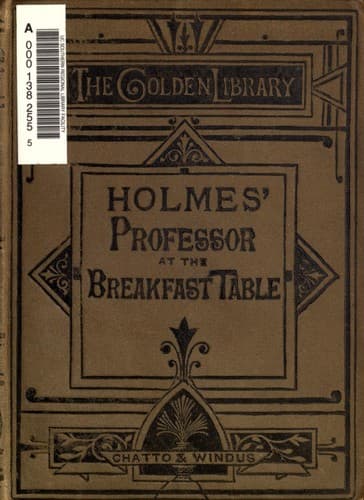
The Professor at the Breakfast-TableHolmes, Oliver Wendell
General
The Professor at the Breakfast-Table
Holmes, Oliver Wendell
American fiction -- 19th century; Conversation -- Fiction; Poetry
They commonly tell the truth about their present feelings, no doubt. A
dying man's deposition about anything he knows is good evidence. But
it is of much less consequence what a man thinks and says when he is
changed by pain, weakness, apprehension, than what he thinks when he is
truly and wholly himself. Most murderers die in a very pious frame of
mind, expecting to go to glory at once; yet no man believes he shall
meet a larger average of pirates and cut-throats in the streets of the
New Jerusalem than of honest folks that died in their beds.
Unfortunately, there has been a very great tendency to make capital of
various kinds out of dying men's speeches. The lies that have been put
into their mouths for this purpose are endless. The prime minister,
whose last breath was spent in scolding his nurse, dies with a
magnificent apothegm on his lips, manufactured by a reporter. Addison
gets up a tableau and utters an admirable sentiment,--or somebody makes
the posthumous dying epigram for him. The incoherent babble of green
fields is translated into the language of stately sentiment. One would
think, all that dying men had to do was to say the prettiest thing
they could,--to make their rhetorical point,--and then bow themselves
politely out of the world.
Worse than this is the torturing of dying people to get their evidence
in favor of this or that favorite belief. The camp-followers of
proselyting sects have come in at the close of every life where they
could get in, to strip the languishing soul of its thoughts, and carry
them off as spoils. The Roman Catholic or other priest who insists on
the reception of his formula means kindly, we trust, and very commonly
succeeds in getting the acquiescence of the subject of his spiritual
surgery, but do not let us take the testimony of people who are in the
worst condition to form opinions as evidence of the truth or falsehood
of that which they accept. A lame man's opinion of dancing is not good
for much. A poor fellow who can neither eat nor drink, who is sleepless
and full of pains, whose flesh has wasted from him, whose blood is like
water, who is gasping for breath, is not in a condition to judge fairly
of human life, which in all its main adjustments is intended for men in
a normal, healthy condition. It is a remark I have heard from the wise
Patriarch of the Medical Profession among us, that the moral condition
of patients with disease above the great breathing-muscle, the
diaphragm, is much more hopeful than that of patients with disease below
it, in the digestive organs. Many an honest ignorant man has given
us pathology when he thought he was giving us psychology. With
this preliminary caution I shall proceed to the story of the Little
Gentleman's leaving us.
Public-domain text, read in full here on John Shaqi.
Reviews
Reviews
No reviews yet
Be the first to share your thoughts on this work.
Elsewhere in the archive
Join the Discussion
Join the discussion
Sign in to leave a comment or review.
Sign InorCreate an account