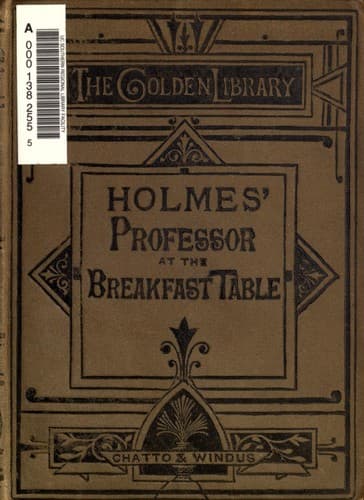
The Professor at the Breakfast-TableHolmes, Oliver Wendell
General
The Professor at the Breakfast-Table
Holmes, Oliver Wendell
American fiction -- 19th century; Conversation -- Fiction; Poetry
When the divinity-student found that our fellow-boarder was not likely
to remain long with us, he, being a young man of tender conscience
and kindly nature, was not a little exercised on his behalf. It was
undeniable that on several occasions the Little Gentleman had expressed
himself with a good deal of freedom on a class of subjects which,
according to the divinity-student, he had no right to form an opinion
upon. He therefore considered his future welfare in jeopardy.
The Muggletonian sect have a very odd way of dealing with people. If
I, the Professor, will only give in to the Muggletonian doctrine, there
shall be no question through all that persuasion that I am competent to
judge of that doctrine; nay, I shall be quoted as evidence of its truth,
while I live, and cited, after I am dead, as testimony in its behalf.
But if I utter any ever so slight Anti-Muggletonian sentiment, then I
become incompetent to form any opinion on the matter. This, you cannot
fail to observe, is exactly the way the pseudo-sciences go to work,
as explained in my Lecture on Phrenology. Now I hold that he whose
testimony would be accepted in behalf of the Muggletonian doctrine has a
right to be heard against it. Whoso offers me any article of belief for
my signature implies that I am competent to form an opinion upon it; and
if my positive testimony in its favor is of any value, then my negative
testimony against it is also of value.
I thought my young friend's attitude was a little too much like that of
the Muggletonians. I also remarked a singular timidity on his part
lest somebody should “unsettle” somebody's faith,--as if faith did not
require exercise as much as any other living thing, and were not all the
better for a shaking up now and then. I don't mean that it would be fair
to bother Bridget, the wild Irish girl, or Joice Heth, the centenarian,
or any other intellectual non-combatant; but all persons who proclaim a
belief which passes judgment on their neighbors must be ready to have it
“unsettled,” that is, questioned, at all times and by anybody,--just
as those who set up bars across a thoroughfare must expect to have them
taken down by every one who wants to pass, if he is strong enough.
Besides, to think of trying to water-proof the American mind against the
questions that Heaven rains down upon it shows a misapprehension of our
new conditions. If to question everything be unlawful and dangerous, we
had better undeclare our independence at once; for what the Declaration
means is the right to question everything, even the truth of its own
fundamental proposition.
Public-domain text, read in full here on John Shaqi.
Reviews
Reviews
No reviews yet
Be the first to share your thoughts on this work.
Elsewhere in the archive
Join the Discussion
Join the discussion
Sign in to leave a comment or review.
Sign InorCreate an account