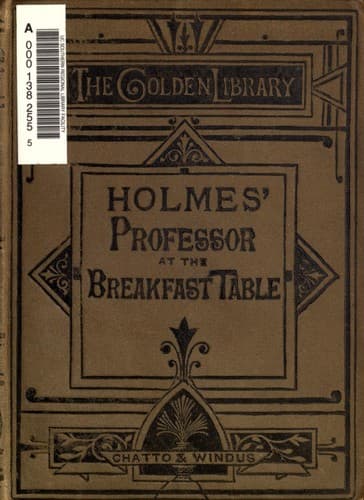
The Professor at the Breakfast-TableHolmes, Oliver Wendell
General
The Professor at the Breakfast-Table
Holmes, Oliver Wendell
American fiction -- 19th century; Conversation -- Fiction; Poetry
As our old boarding-house is still in existence, I do not feel at
liberty to give too minute a statement of the present condition of each
and all of its inmates. I am happy to say, however, that they are all
alive and well, up to this time. That amiable old gentleman who sat
opposite to me is growing older, as old men will, but still smiles
benignantly on all the boarders, and has come to be a kind of father to
all of them,--so that on his birthday there is always something like
a family festival. The Poor Relation, even, has warmed into a filial
feeling towards him, and on his last birthday made him a beautiful
present, namely, a very handsomely bound copy of Blair's celebrated
poem, “The Grave.”
The young man John is still, as he says, “in fustrate fettle.” I saw
him spar, not long since, at a private exhibition, and do himself great
credit in a set-to with Henry Finnegass, Esq., a professional gentleman
of celebrity. I am pleased to say that he has been promoted to an upper
clerkship, and, in consequence of his rise in office, has taken
an apartment somewhat lower down than number “forty-'leven,” as he
facetiously called his attic. Whether there is any truth, or not, in the
story of his attachment to, and favorable reception by, the daughter of
the head of an extensive wholesale grocer's establishment, I will not
venture an opinion; I may say, however, that I have met him repeatedly
in company with a very well-nourished and high-colored young lady, who,
I understand, is the daughter of the house in question.
Some of the boarders were of opinion that Iris did not return the
undisguised attentions of the handsome young Marylander. Instead of
fixing her eyes steadily on him, as she used to look upon the Little
Gentleman, she would turn them away, as if to avoid his own. They often
went to church together, it is true; but nobody, of course, supposes
there is any relation between religious sympathy and those wretched
“sentimental” movements of the human heart upon which it is commonly
agreed that nothing better is based than society, civilization,
friendship, the relation of husband and wife, and of parent and child,
and which many people must think were singularly overrated by the
Teacher of Nazareth, whose whole life, as I said before, was full of
sentiment, loving this or that young man, pardoning this or that sinner,
weeping over the dead, mourning for the doomed city, blessing, and
perhaps kissing, the little children, so that the Gospels are still
cried over almost as often as the last work of fiction!
Public-domain text, read in full here on John Shaqi.
Reviews
Reviews
No reviews yet
Be the first to share your thoughts on this work.
Elsewhere in the archive
Join the Discussion
Join the discussion
Sign in to leave a comment or review.
Sign InorCreate an account