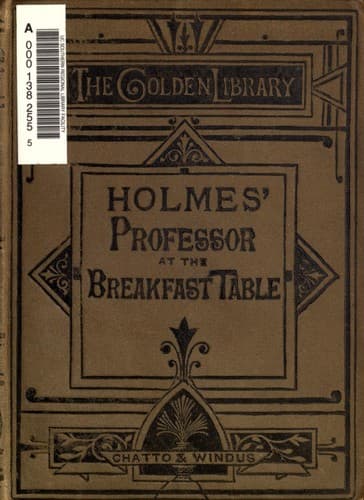
The Professor at the Breakfast-TableHolmes, Oliver Wendell
General
The Professor at the Breakfast-Table
Holmes, Oliver Wendell
American fiction -- 19th century; Conversation -- Fiction; Poetry
But one fine June morning there rumbled up to the door of our
boarding-house a hack containing a lady inside and a trunk on the
outside. It was our friend the lady-patroness of Miss Iris, the same who
had been called by her admiring pastor “The Model of all the Virtues.”
Once a week she had written a letter, in a rather formal hand, but full
of good advice, to her young charge. And now she had come to carry her
away, thinking that she had learned all she was likely to learn
under her present course of teaching. The Model, however, was to stay
awhile,--a week, or more,--before they should leave together.
Iris was obedient, as she was bound to be. She was respectful, grateful,
as a child is with a just, but not tender parent. Yet something was
wrong. She had one of her trances, and became statue-like, as before,
only the day after the Model's arrival. She was wan and silent, tasted
nothing at table, smiled as if by a forced effort, and often looked
vaguely away from those who were looking at her, her eyes just glazed
with the shining moisture of a tear that must not be allowed to gather
and fall. Was it grief at parting from the place where her strange
friendship had grown up with the Little Gentleman? Yet she seemed to
have become reconciled to his loss, and rather to have a deep feeling of
gratitude that she had been permitted to care for him in his last weary
days.
The Sunday after the Model's arrival, that lady had an attack of
headache, and was obliged to shut herself up in a darkened room alone.
Our two young friends took the opportunity to go together to the
Church of the Galileans. They said but little going,--“collecting their
thoughts” for the service, I devoutly hope. My kind good friend the
pastor preached that day one of his sermons that make us all feel like
brothers and sisters, and his text was that affectionate one from John,
“My little children, let us not love in word, neither in tongue, but in
deed and in truth.” When Iris and her friend came out of church, they
were both pale, and walked a space without speaking.
At last the young man said,--You and I are not little children, Iris!
She looked in his face an instant, as if startled, for there was
something strange in the tone of his voice. She smiled faintly, but
spoke never a word.
In deed and in truth, Iris,---
What shall a poor girl say or do, when a strong man falters in his
speech before her, and can do nothing better than hold out his hand to
finish his broken sentence?
The poor girl said nothing, but quietly laid her ungloved hand in
his,--the little soft white hand which had ministered so tenderly and
suffered so patiently.
The blood came back to the young man's cheeks, as he lifted it to his
lips, even as they walked there in the street, touched it gently with
them, and said, “It is mine!”
Iris did not contradict him.
Public-domain text, read in full here on John Shaqi.
Reviews
Reviews
No reviews yet
Be the first to share your thoughts on this work.
Elsewhere in the archive
Join the Discussion
Join the discussion
Sign in to leave a comment or review.
Sign InorCreate an account