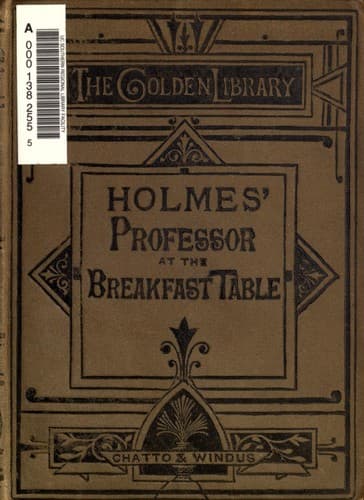
The Professor at the Breakfast-TableHolmes, Oliver Wendell
General
The Professor at the Breakfast-Table
Holmes, Oliver Wendell
American fiction -- 19th century; Conversation -- Fiction; Poetry
for; and a kind letter in it, written with the best of feeling, in
the worst of Latin, pointed delicately to its destination. Out of this
silver vessel, after a long, desperate, strangling cry, which marked
her first great lesson in the realities of life, the child took the blue
milk, such as poor tutors and their children get, tempered with
water, and sweetened a little, so as to bring it nearer the standard
established by the touching indulgence and partiality of Nature,--who
had mingled an extra allowance of sugar in the blameless food of the
child at its mother's breast, as compared with that of its infant
brothers and sisters of the bovine race.
But a willow will grow in baked sand wet with rainwater. An air-plant
will grow by feeding on the winds. Nay, those huge forests that
overspread great continents have built themselves up mainly from the
air-currents with which they are always battling. The oak is but a
foliated atmospheric crystal deposited from the aerial ocean that holds
the future vegetable world in solution. The storm that tears its leaves
has paid tribute to its strength, and it breasts the tornado clad in the
spoils of a hundred hurricanes.
Poor little Iris! What had she in common with the great oak in the
shadow of which we are losing sight of her?--She lived and grew like
that,--this was all. The blue milk ran into her veins and filled them
with thin, pure blood. Her skin was fair, with a faint tinge, such as
the white rosebud shows before it opens. The doctor who had attended
her father was afraid her aunt would hardly be able to “raise”
her,--“delicate child,”--hoped she was not consumptive,--thought there
was a fair chance she would take after her father.
A very forlorn-looking person, dressed in black, with a white neckcloth,
sent her a memoir of a child who died at the age of two years and eleven
months, after having fully indorsed all the doctrines of the particular
persuasion to which he not only belonged himself, but thought it very
shameful that everybody else did not belong. What with foreboding looks
and dreary death-bed stories, it was a wonder the child made out to live
through it. It saddened her early years, of course,--it distressed
her tender soul with thoughts which, as they cannot be fully taken in,
should be sparingly used as instruments of torture to break down the
natural cheerfulness of a healthy child, or, what is infinitely worse,
to cheat a dying one out of the kind illusions with which the Father of
All has strewed its downward path.
The child would have died, no doubt, and, if properly managed, might
have added another to the long catalogue of wasting children who have
been as cruelly played upon by spiritual physiologists, often with the
best intentions, as ever the subject of a rare disease by the curious
students of science.
Public-domain text, read in full here on John Shaqi.
Reviews
Reviews
No reviews yet
Be the first to share your thoughts on this work.
Join the Discussion
Join the discussion
Sign in to leave a comment or review.
Sign InorCreate an account