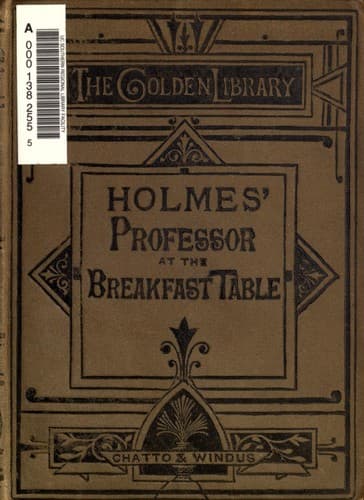
The Professor at the Breakfast-TableHolmes, Oliver Wendell
General
The Professor at the Breakfast-Table
Holmes, Oliver Wendell
American fiction -- 19th century; Conversation -- Fiction; Poetry
It is only incidentally, however, that the Professor at the
Breakfast-Table handles matters which are the subjects of religious
controversy. The reader who is sensitive about having his fixed beliefs
dealt with as if they were open to question had better skip the pages
which look as if they would disturb his complacency. “Faith” is the most
precious of possessions, and it dislikes being meddled with. It means,
of course, self-trust,--that is, a belief in the value of our own
opinion of a doctrine, of a church, of a religion, of a Being, a belief
quite independent of any evidence that we can bring to convince a jury
of our fellow beings. Its roots are thus inextricably entangled with
those of self-love and bleed as mandrakes were said to, when pulled up
as weeds. Some persons may even at this late day take offence at a few
opinions expressed in the following pages, but most of these passages
will be read without loss of temper by those who disagree with them, and
by-and-by they may be found too timid and conservative for intelligent
readers, if they are still read by any.
BEVERLY FARM, MASS., June 18, 1891. O. W. H.
THE PROFESSOR AT THE BREAKFAST-TABLE.
What he said, what he heard, and what he saw.
I
I intended to have signalized my first appearance by a certain large
statement, which I flatter myself is the nearest approach to a universal
formula, of life yet promulgated at this breakfast-table. It would
have had a grand effect. For this purpose I fixed my eyes on a certain
divinity-student, with the intention of exchanging a few phrases, and
then forcing my court-card, namely, The great end of being.--I will
thank you for the sugar,--I said.--Man is a dependent creature.
It is a small favor to ask,--said the divinity-student,--and passed the
sugar to me.
--Life is a great bundle of little things,--I said.
The divinity-student smiled, as if that were the concluding epigram of
the sugar question.
You smile,--I said.--Perhaps life seems to you a little bundle of great
things?
The divinity-student started a laugh, but suddenly reined it back with a
pull, as one throws a horse on his haunches.--Life is a great bundle of
great things,--he said.
(NOW, THEN!) The great end of being, after all, is....
Hold on!--said my neighbor, a young fellow whose name seems to be John,
and nothing else,--for that is what they all call him,--hold on! the
Sculpin is go'n' to say somethin'.
Public-domain text, read in full here on John Shaqi.
Reviews
Reviews
No reviews yet
Be the first to share your thoughts on this work.
Join the Discussion
Join the discussion
Sign in to leave a comment or review.
Sign InorCreate an account