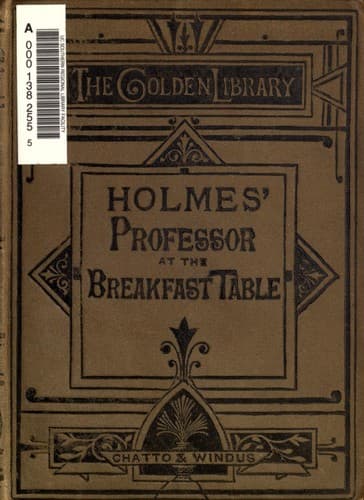
The Professor at the Breakfast-TableHolmes, Oliver Wendell
General
The Professor at the Breakfast-Table
Holmes, Oliver Wendell
American fiction -- 19th century; Conversation -- Fiction; Poetry
Perhaps some think we ought not to talk at table about such things.--I
am not so sure of that. Religion and government appear to me the two
subjects which of all others should belong to the common talk of people
who enjoy the blessings of freedom. Think, one moment. The earth is a
great factory-wheel, which, at every revolution on its axis, receives
fifty thousand raw souls and turns off nearly the same number worked
up more or less completely. There must be somewhere a population of
two hundred thousand million, perhaps ten or a hundred times as many,
earth-born intelligences. Life, as we call it, is nothing but the edge
of the boundless ocean of existence where it comes on soundings. In
this view, I do not see anything so fit to talk about, or half so
interesting, as that which relates to the innumerable majority of our
fellow-creatures, the dead-living, who are hundreds of thousands to one
of the live-living, and with whom we all potentially belong, though we
have got tangled for the present in some parcels of fibrine, albumen,
and phosphates, that keep us on the minority side of the house. In
point of fact, it is one of the many results of Spiritualism to make
the permanent destiny of the race a matter of common reflection and
discourse, and a vehicle for the prevailing disbelief of the Middle-Age
doctrines on the subject. I cannot help thinking, when I remember how
many conversations my friend and myself have sported, that it would be
very extraordinary, if there were no mention of that class of subjects
which involves all that we have and all that we hope, not merely for
ourselves, but for the dear people whom we love best,--noble men, pure
and lovely women, ingenuous children, about the destiny of nine tenths
of whom you know the opinions that would have been taught by those
old man-roasting, woman-strangling dogmatists.--However, I fought this
matter with one of our boarders the other day, and I am going to report
the conversation.
The divinity-student came down, one morning, looking rather more serious
than usual. He said little at breakfast-time, but lingered after the
others, so that I, who am apt to be long at the table, found myself
alone with him.
When the rest were all gone, he turned his chair round towards mine, and
began.
I am afraid,--he said,--you express yourself a little too freely on a
most important class of subjects. Is there not danger in introducing
discussions or allusions relating to matters of religion into common
discourse?
Danger to what?--I asked.
Danger to truth,--he replied, after a slight pause.
I didn't know Truth was such an invalid,' I said.--How long is it since
she could only take the air in a close carriage, with a gentleman in
a black coat on the box? Let me tell you a story, adapted to young
persons, but which won't hurt older ones.
Public-domain text, read in full here on John Shaqi.
Reviews
Reviews
No reviews yet
Be the first to share your thoughts on this work.
Elsewhere in the archive
Join the Discussion
Join the discussion
Sign in to leave a comment or review.
Sign InorCreate an account