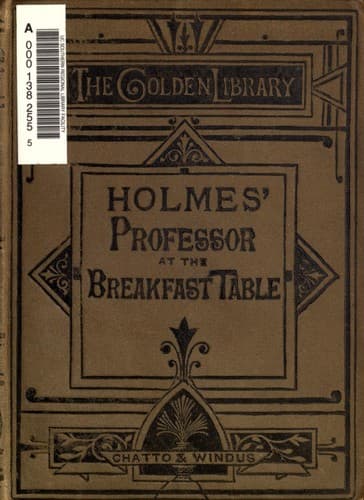
The Professor at the Breakfast-TableHolmes, Oliver Wendell
General
The Professor at the Breakfast-Table
Holmes, Oliver Wendell
American fiction -- 19th century; Conversation -- Fiction; Poetry
--There was a very little boy who had one of those balloons you may have
seen, which are filled with light gas, and are held by a string to keep
them from running off in aeronautic voyages on their own account. This
little boy had a naughty brother, who said to him, one day,--Brother,
pull down your balloon, so that I can look at it and take hold of it.
Then the little boy pulled it down. Now the naughty brother had a sharp
pin in his hand, and he thrust it into the balloon, and all the gas
oozed out, so that there was nothing left but a shrivelled skin.
One evening, the little boy's father called him to the window to see the
moon, which pleased him very much; but presently he said,--Father, do
not pull the string and bring down the moon, for my naughty brother will
prick it, and then it will all shrivel up and we shall not see it any
more.
Then his father laughed, and told him how the moon had been shining a
good while, and would shine a good while longer, and that all we could
do was to keep our windows clean, never letting the dust get too thick
on them, and especially to keep our eyes open, but that we could not
pull the moon down with a string, nor prick it with a pin.--Mind you
this, too, the moon is no man's private property, but is seen from a
good many parlor-windows.
--Truth is tough. It will not break, like a bubble, at a touch; nay,
you may kick it about all day, like a football, and it will be round and
full at evening. Does not Mr. Bryant say, that Truth gets well if she is
run over by a locomotive, while Error dies of lockjaw if she scratches
her finger? [Would that this was so:--error, superstition, mysticism,
authoritarianism, pseudo-science all have a tenacity that survives
inexplicably. D.W.] I never heard that a mathematician was alarmed for
the safety of a demonstrated proposition. I think, generally, that fear
of open discussion implies feebleness of inward conviction, and great
sensitiveness to the expression of individual opinion is a mark of
weakness.
--I am not so much afraid for truth,--said the divinity-student,--as for
the conceptions of truth in the minds of persons not accustomed to judge
wisely the opinions uttered before them.
Would you, then, banish all allusions to matters of this nature from the
society of people who come together habitually?
I would be very careful in introducing them,--said the divinity-student.
Yes, but friends of yours leave pamphlets in people's entries, to be
picked up by nervous misses and hysteric housemaids, full of doctrines
these people do not approve. Some of your friends stop little children
in the street, and give them books, which their parents, who have had
them baptized into the Christian fold and give them what they consider
proper religious instruction, do not think fit for them. One would
say it was fair enough to talk about matters thus forced upon people's
attention.
Public-domain text, read in full here on John Shaqi.
Reviews
Reviews
No reviews yet
Be the first to share your thoughts on this work.
Elsewhere in the archive
Join the Discussion
Join the discussion
Sign in to leave a comment or review.
Sign InorCreate an account