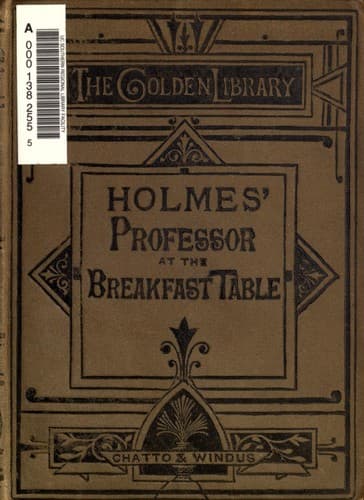
The Professor at the Breakfast-TableHolmes, Oliver Wendell
General
The Professor at the Breakfast-Table
Holmes, Oliver Wendell
American fiction -- 19th century; Conversation -- Fiction; Poetry
The divinity-student could not deny that this was what might be called
opening the subject to the discussion of intelligent people.
But,--he said,--the greatest objection is this, that persons who have
not made a professional study of theology are not competent to speak on
such subjects. Suppose a minister were to undertake to express opinions
on medical subjects, for instance, would you not think he was going
beyond his province?
I laughed,--for I remembered John Wesley's “sulphur and supplication,”
and so many other cases where ministers had meddled with
medicine,--sometimes well and sometimes ill, but, as a general rule,
with a tremendous lurch to quackery, owing to their very loose way of
admitting evidence,--that I could not help being amused.
I beg your pardon,--I said,--I do not wish to be impolite, but I was
thinking of their certificates to patent medicines. Let us look at this
matter.
If a minister had attended lectures on the theory and practice of
medicine, delivered by those who had studied it most deeply, for thirty
or forty years, at the rate of from fifty to one hundred a year,--if
he had been constantly reading and hearing read the most approved
text-books on the subject,--if he had seen medicine actually practised
according to different methods, daily, for the same length of time,--I
should think, that if a person of average understanding, he was entitled
to express an opinion on the subject of medicine, or else that his
instructors were a set of ignorant and incompetent charlatans.
If, before a medical practitioner would allow me to enjoy the full
privileges of the healing art, he expected me to affirm my belief in a
considerable number of medical doctrines, drugs, and formulae, I should
think that he thereby implied my right to discuss the same, and my
ability to do so, if I knew how to express myself in English.
Suppose, for instance, the Medical Society should refuse to give us an
opiate, or to set a broken limb, until we had signed our belief in a
certain number of propositions,--of which we will say this is the first:
I. All men's teeth are naturally in a state of total decay or caries,
and, therefore, no man can bite until every one of them is extracted and
a new set is inserted according to the principles of dentistry adopted
by this Society.
Public-domain text, read in full here on John Shaqi.
Reviews
Reviews
No reviews yet
Be the first to share your thoughts on this work.
Elsewhere in the archive
Join the Discussion
Join the discussion
Sign in to leave a comment or review.
Sign InorCreate an account