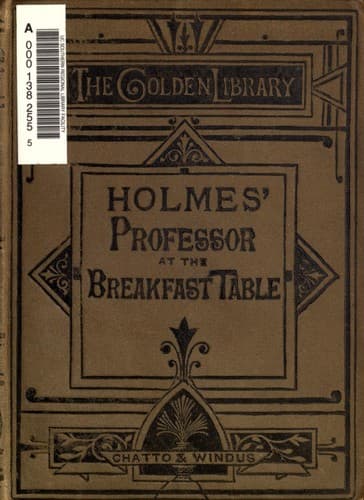
The Professor at the Breakfast-TableHolmes, Oliver Wendell
General
The Professor at the Breakfast-Table
Holmes, Oliver Wendell
American fiction -- 19th century; Conversation -- Fiction; Poetry
Apologizing.--A very desperate habit,--one that is rarely cured. Apology
is only egotism wrong side out. Nine times out of ten, the first thing
a man's companion knows of his shortcoming is from his apology. It is
mighty presumptuous on your part to suppose your small failures of so
much consequence that you must make a talk about them.
Good dressing, quiet ways, low tones of voice, lips that can wait, and
eyes that do not wander,--shyness of personalities, except in certain
intimate communions,--to be light in hand in conversation, to have
ideas, but to be able to make talk, if necessary, without them,--to
belong to the company you are in, and not to yourself,--to have nothing
in your dress or furniture so fine that you cannot afford to spoil it
and get another like it, yet to preserve the harmonies, throughout
your person and--dwelling: I should say that this was a fair capital of
manners to begin with.
Under bad manners, as under graver faults, lies very commonly an
overestimate of our special individuality, as distinguished from our
generic humanity. It is just here that the very highest society asserts
its superior breeding. Among truly elegant people of the highest ton,
you will find more real equality in social intercourse than in a country
village. As nuns drop their birth-names and become Sister Margaret and
Sister Mary, so high-bred people drop their personal distinctions
and become brothers and sisters of conversational charity. Nor are
fashionable people without their heroism. I believe there are men who
have shown as much self-devotion in carrying a lone wall-flower down to
the supper-table as ever saint or martyr in the act that has canonized
his name. There are Florence Nightingales of the ballroom, whom nothing
can hold back from their errands of mercy. They find out the red-handed,
gloveless undergraduate of bucolic antecedents, as he squirms in his
corner, and distill their soft words upon him like dew upon the green
herb. They reach even the poor relation, whose dreary apparition saddens
the perfumed atmosphere of the sumptuous drawing-room. I have known one
of these angels ask, of her own accord, that a desolate middle-aged man,
whom nobody seemed to know, should be presented to her by the hostess.
He wore no shirt-collar,--he had on black gloves,--and was flourishing a
red bandanna handkerchief! Match me this, ye proud children of poverty,
who boast of your paltry sacrifices for each other! Virtue in humble
life! What is that to the glorious self-renunciation of a martyr in
pearls and diamonds? As I saw this noble woman bending gracefully before
the social mendicant,--the white billows of her beauty heaving under
the foam of the traitorous laces that half revealed them,--I should
have wept with sympathetic emotion, but that tears, except as a private
demonstration, are an ill-disguised expression of self-consciousness and
vanity, which is inadmissible in good society.
Public-domain text, read in full here on John Shaqi.
Reviews
Reviews
No reviews yet
Be the first to share your thoughts on this work.
Elsewhere in the archive
Join the Discussion
Join the discussion
Sign in to leave a comment or review.
Sign InorCreate an account