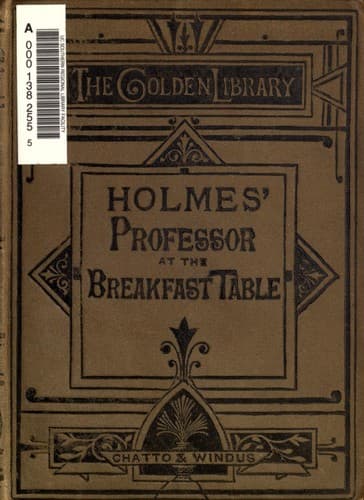
The Professor at the Breakfast-TableHolmes, Oliver Wendell
General
The Professor at the Breakfast-Table
Holmes, Oliver Wendell
American fiction -- 19th century; Conversation -- Fiction; Poetry
I have sometimes thought, with a pang, of the position in which
political chance or contrivance might hereafter place some one of
our fellow-citizens. It has happened hitherto, so far as my limited
knowledge goes, that the President of the United States has always been
what might be called in general terms a gentleman. But what if at some
future time the choice of the people should fall upon one on whom that
lofty title could not, by any stretch of charity, be bestowed? This may
happen,--how soon the future only knows. Think of this miserable man
of coming political possibilities,--an unpresentable boor sucked into
office by one of those eddies in the flow of popular sentiment which
carry straws and chips into the public harbor, while the prostrate
trunks of the monarchs of the forest hurry down on the senseless stream
to the gulf of political oblivion! Think of him, I say, and of the
concentrated gaze of good society through its thousand eyes, all
confluent, as it were, in one great burning-glass of ice that shrivels
its wretched object in fiery torture, itself cold as the glacier of an
unsunned cavern! No,--there will be angels of good-breeding then as
now, to shield the victim of free institutions from himself and from his
torturers. I can fancy a lovely woman playfully withdrawing the knife
which he would abuse by making it an instrument for the conveyance
of food,--or, failing in this kind artifice, sacrificing herself by
imitating his use of that implement; how much harder than to plunge it
into her bosom, like Lucretia! I can see her studying in his provincial
dialect until she becomes the Champollion of New England or Western
or Southern barbarisms. She has learned that haow means what; that
think-in' is the same thing as thinking, or she has found out the
meaning of that extraordinary mono syllable, which no single-tongued
phonographer can make legible, prevailing on the banks of the Hudson and
at its embouchure, and elsewhere,--what they say when they think they
say first, (fe-eest,--fe as in the French le),--or that cheer
means chair,--or that urritation means irritation,--and so of other
enormities. Nothing surprises her. The highest breeding, you know,
comes round to the Indian standard,--to take everything coolly,--nil
admirari,--if you happen to be learned and like the Roman phrase for the
same thing.
If you like the company of people that stare at you from head to foot to
see if there is a hole in your coat, or if you have not grown a
little older, or if your eyes are not yellow with jaundice, or if your
complexion is not a little faded, and so on, and then convey the fact
to you, in the style in which the Poor Relation addressed the
divinity-student,--go with them as much as you like. I hate the sight of
the wretches. Don't for mercy's sake think I hate them; the distinction
is one my friend or I drew long ago. No matter where you find such
people; they are clowns.
Public-domain text, read in full here on John Shaqi.
Reviews
Reviews
No reviews yet
Be the first to share your thoughts on this work.
Elsewhere in the archive
Join the Discussion
Join the discussion
Sign in to leave a comment or review.
Sign InorCreate an account