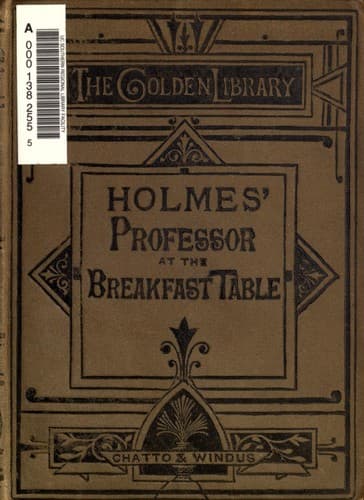
The Professor at the Breakfast-TableHolmes, Oliver Wendell
General
The Professor at the Breakfast-Table
Holmes, Oliver Wendell
American fiction -- 19th century; Conversation -- Fiction; Poetry
This brief syllogism, and its briefer negative, involving the principle
which some English conveyancer borrowed from a French wit and embodied
in the lines by which Dr. Fell is made unamiably immortal, this
syllogism, I say, is one that most persons have had occasion to
construct and demolish, respecting somebody or other, as I have done for
the Model. “Pious and painefull.” Why has that excellent old phrase gone
out of use? Simply because these good painefull or painstaking persons
proved to be such nuisances in the long run, that the word “painefull”
came, before people thought of it, to mean pain-giving instead of
painstaking.
--So, the old fellah's off to-morrah,--said the young man John.
Old fellow?--said I,--whom do you mean?
Why, the one that came with our little beauty, the old fellah in
petticoats.
--Now that means something,--said I to myself.--These rough young
rascals very often hit the nail on the head, if they do strike with
their eyes shut. A real woman does a great many things without knowing
why she does them; but these pattern machines mix up their intellects
with everything they do, just like men. They can't help it, no doubt;
but we can't help getting sick of them, either. Intellect is to a
woman's nature what her watch-spring skirt is to her dress; it ought
to underlie her silks and embroideries, but not to show itself too
staringly on the outside.--You don't know, perhaps, but I will tell
you; the brain is the palest of all the internal organs, and the heart
the reddest. Whatever comes from the brain carries the hue of the place
it came from, and whatever comes from the heart carries the heat and
color of its birthplace.
The young man John did not hear my soliloquy, of course, but sent up one
more bubble from our sinking conversation, in the form of a statement,
that she was at liberty to go to a personage who receives no visits, as
is commonly supposed, from virtuous people.
Public-domain text, read in full here on John Shaqi.
Reviews
Reviews
No reviews yet
Be the first to share your thoughts on this work.
Elsewhere in the archive
Join the Discussion
Join the discussion
Sign in to leave a comment or review.
Sign InorCreate an account