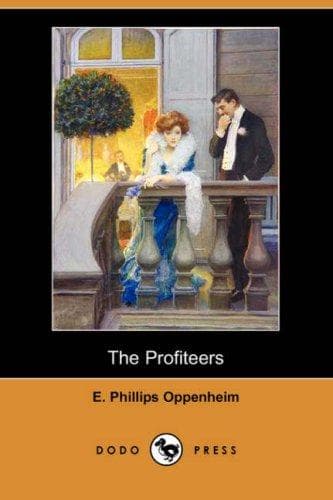
The ProfiteersOppenheim, E. Phillips (Edward Phillips)
General
The Profiteers
Oppenheim, E. Phillips (Edward Phillips)
Detective and mystery stories
"One word," Kendrick begged, relapsing for a moment into his ordinary
manner as he touched Wingate on the shoulder. "Dredlinton is here, rather
drunk and very quarrelsome. I heard him telling some one about having
found you dining alone with his wife to-night. Phipps was listening. Look
at him, as black as a thundercloud! Keep your head if Dredlinton gets
troublesome."
Wingate nodded and was promptly led away. They found places about
half-way down the great horseshoe table, laden with flowers and every
sort of cold delicacy. There were champagne bottles at every other
place, a small crowd of waiters, eager to justify their existence,--a
rollicking, Bohemian crowd, the _jeunesse dorée_ of London, and all the
talent and beauty of the musical comedy stage. It was a side of life with
which Wingate was somewhat unfamiliar. Nevertheless, his feet that night
were resting upon the clouds. Any form of life was sweet to him. The new
joy in his heart warmed his pulses, lightened his tongue, unlocked a new
geniality. He was disposed to talk with everybody. The young lady by his
side, however, had other views.
"Do you like our show, Mr. Wingate?" she asked. "Or perhaps you don't go
to musical comedies? I am in 'Lady Diana,' you know."
"One of the very first things I am going to see," Wingate replied, "but
as a matter of fact, I only arrived from America a few days ago. I hear
that you are a great success."
It took the young lady very nearly a quarter of an hour to explain how
greatly the play might be improved and strengthened by the allotment to
her of a few more songs and another dance, and she also recounted the
argument she had had with the stage manager as to her absence from the
stage during the greater part of Act Two.
"I am not vain," she concluded, with engaging frankness, "but on the
other hand I am not foolish, and I know quite well that many people--a
great part of the audience, in fact--come because they see my name upon
the boards, and I have numberless complaints because I am only on for
such a short time in what should be the most important act of the play. I
tell them it's nothing to do with me, but as long as my name is displayed
outside the theatre and I know how they feel about it, I feel a certain
responsibility. Now you are a very clever man, and a man of the world,
Mr. Wingate. What do you think about it?"
"I think that you are quite right," he declared, with satisfactory
emphasis.
"You don't know Mr. Maken, our manager, I suppose?" she enquired.
Wingate shook his head.
"As a matter of fact," he confessed, "I know very few theatrical people."
"What a pity you're not fond of the stage!" she sighed, with a world of
regret in her very blue eyes. "You might have a theatre of your own, and
a leading lady, and all the rest of it."
"It sounds rather fascinating," he admitted, "under certain
circumstances. All the same, I don't think I should like to make a
business of what is such a great pleasure."
Public-domain text, read in full here on John Shaqi.
Reviews
Reviews
No reviews yet
Be the first to share your thoughts on this work.
Join the Discussion
Join the discussion
Sign in to leave a comment or review.
Sign InorCreate an account