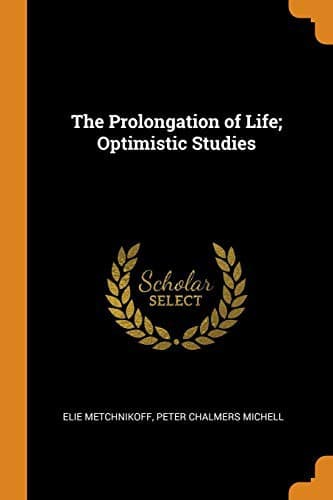
The Prolongation of Life: Optimistic StudiesMetchnikoff, Elie
Science
The Prolongation of Life: Optimistic Studies
Metchnikoff, Elie
Aging; Hygiene; Longevity; Older people -- Social conditions
I have already shown, in the “Nature of Man,” the difference which
exists between senile degeneration in our own bodies and the phenomena
of senescence amongst Infusoria which, as M. Maupas described, are
followed by a process of rejuvenescence. According to the more recent
results of several investigators, the difference is still greater than
I had supposed. Enriquez[4] has been able to propagate Infusoria to
the 700th generation without any sign of senility being displayed. Here
we are far from the condition in the human race.
R. Hertwig,[5] one of the best observers of the lower animals, has
recently attempted to show that the very simple animalculæ of the genus
_Actinosphærium_ are subject to true physiological degeneration. He
has several times seen cultures of this Rhizopod degenerate, until all
the individuals had died, notwithstanding the presence of abundant
food. Prof. Hertwig attributed this to the “constitution of the
_Actinosphærium_ having been weakened by too great vital activity
at an earlier stage.” I should have thought that it was a much more
natural explanation to suppose that the culture had undergone infection
by one of the contagious diseases which so often destroy cultures of
different kinds of lower animals and plants. As this idea had not
occurred to the observer, he had not searched for parasitic microbes
amongst the granulations which are always present in the body of an
_Actinosphærium_. However this may be, I cannot accept the facts
brought forward by this distinguished German as a valid proof of the
existence of senile degeneration in these lowly creatures.
The facts that I have brought together in this chapter justify the
conclusion that human beings who reach extreme old age may preserve
their mental qualities notwithstanding serious physical decay.
Moreover, it is equally plain that the organism of some vertebrates is
able to resist the influence of time much longer than is the case with
man under present conditions.
II
THEORIES OF CAUSATION OF SENILITY
Hypothesis of the causation of senility—Senility
cannot be attributed to the cessation of the power
of reproduction of the cells of the body—Growth of
the hair and the nails in old age—Inner mechanism of
the senescence of the tissues—Notwithstanding the
criticisms of M. Marinesco, the neuronophags are true
phagocytes—The whitening of hair and the destruction of
nerve cells, as arguments against a theory of old age
based on the failure of the reproductive powers of the
cells
Although it has not been proved that living matter must inevitably
undergo senile decrepitude, it is none the less true that man and his
nearest allies generally exhibit such degeneration. It is therefore
extremely important to recognise the real causes of our senescence.
There have been many hypotheses on the subject, but there are
comparatively few definite facts known.
Public-domain text, read in full here on John Shaqi.
Reviews
Reviews
No reviews yet
Be the first to share your thoughts on this work.
Join the Discussion
Join the discussion
Sign in to leave a comment or review.
Sign InorCreate an account