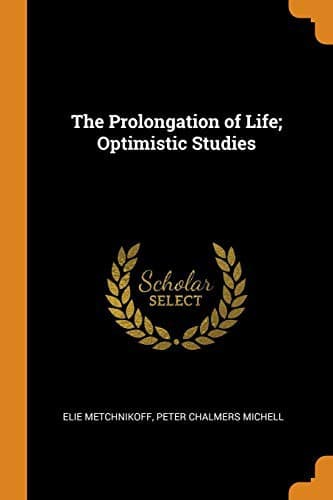
The Prolongation of Life: Optimistic StudiesMetchnikoff, Elie
Science
The Prolongation of Life: Optimistic Studies
Metchnikoff, Elie
Aging; Hygiene; Longevity; Older people -- Social conditions
The facts which I described in the chapter of this book dealing with
old age have made clear how long sexuality persists in men. As the
testes resist atrophy better than other organs, and even in extreme old
age still form active spermatozoa, it is natural that their condition
should be reflected on the organism generally, and that feelings of
love should still be excited. If by some accident Goethe had become
a eunuch early in life, he would have been a different being. The
moralists who have been shocked by his amorous intrigues would have
been satisfied, but the world would have lost a great poet. Moreover,
Goethe is no exceptional case amongst writers. The temperament of
Victor Hugo and his devotion to women up to the end of his days are
well known. More recently, after the death of Ibsen, a profound
sensation was made by the revelation of his love for Mademoiselle
Bardach, who inspired his genius during the last period of his life.
Not only poetic creation but other forms of genius are intimately
associated with the sexual function. The philosopher Schopenhauer, who
was no ascetic, wrote as follows, at the age of twenty-five, when he
was in full creative activity, “In the days and at the hours when the
voluptuous instinct is strongest, when it is a burning covetousness,
it is then that the greatest forces of the mind and the greatest
stores of knowledge are ready for the most intense activity.” “At
such moments life is truly at its strongest and most active, for its
two poles are then operating most actively; and this is plain in the
man of the highest intelligence. In these hours one sees more than in
years of passivity” (quoted in Moebius’ _Schopenhauer_, p. 55). “This
means that in Schopenhauer intellectual creation was linked with erotic
excitement” (_ibid._, p. 57).
It was facts of such a nature that led Brown-Séquard to his idea of
strengthening cerebral activity by injections of the substance of
testes. To obtain the same effect, he prescribed another means, the
value of which was proved in the case of two individuals aged from
forty-five to fifty years, the observations being continued over
several years. “By my advice,” he said, “when these had to perform
any great physical or intellectual work, they got themselves into a
condition of sexual excitement.” “The testes being in this way thrown
into functional activity, there was soon produced the desired increase
in the power of the nerve centres.”[198]
Although I insist on the existence of a close relation between
intellectual activity and the sexual function, I do not mean to assert
that there have not existed exceptions to the rule.
Now that I have described certain important factors in the genius of
Goethe, I shall pass on to a study of his state of mind in the last
period of his life, the splendour and harmony of which have been so
often admired.
III
GOETHE’S OLD AGE
Public-domain text, read in full here on John Shaqi.
Reviews
Reviews
No reviews yet
Be the first to share your thoughts on this work.
Elsewhere in the archive
Join the Discussion
Join the discussion
Sign in to leave a comment or review.
Sign InorCreate an account