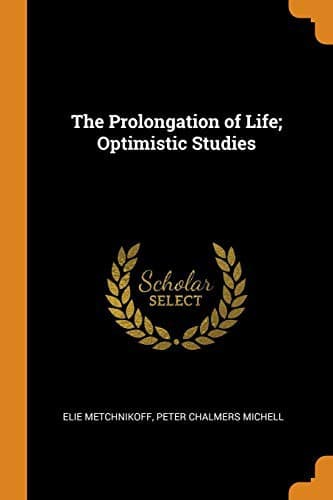
The Prolongation of Life: Optimistic StudiesMetchnikoff, Elie
Science
The Prolongation of Life: Optimistic Studies
Metchnikoff, Elie
Aging; Hygiene; Longevity; Older people -- Social conditions
The Taoists represent their saints, in the shade of willows, seeking
the elixir of life, and in Chinese Buddhist temples there are placed
votive cakes shaped like the tortoise, a sacred animal and the symbol
of long life. Worshippers let stones of divination fall on these cakes
and so ascertained if their lives were to be prolonged, promising for
each subsequent year as many cakes as the divinity might demand.
The mysticism of the East reached Europe in the Middle Ages, and then,
and even in modern times, drugs were used to prolong life. Cagliostro,
the celebrated quack of the eighteenth century, boasted that he had
discovered an elixir of life by the use of which he had survived for
many thousand years.
There still exists, in some modern pharmacopœias, an “elixir ad
longam vitam” compounded of aloes and other purgatives. Analogous
preparations are known, such as the “vital essence of Augsburg” which
is a mixture of purgatives and resins.
Serious physicians have rejected such preparations of the quacks.
They have abandoned the search for a specific, and, in their efforts
to prolong human life, have relied on common rules of hygiene, such
as cleanliness, exercise, fresh air, and general sobriety. In our own
days, Brown-Séquard is an isolated instance of a seeker for a specific
against senescence. This distinguished physiologist, setting out from
the view that the weakness of old men is due partly to diminution of
the secretions of the testes, hoped to find a remedy in the employment
of subcutaneous injections of emulsions of the testes of animals
(dogs and guinea-pigs). Brown-Séquard,[110] then aged 72 years, gave
himself several such injections, and declared that he found himself
reinforced and rejuvenated. Since then, numbers of persons have
undergone the treatment which for a time was in vogue. The observations
of physicians, made on old men and sick persons, have not justified the
hopes which were entertained of the mode of treatment. Fürbringer,[111]
in particular, working in Germany, has discredited the injections of
Brown-Séquard. However, instead of following exactly the original
prescription, Fürbringer employed a testicular emulsion which had
been previously raised to the boiling-point. Brown-Séquard’s method
has not resisted scientific investigation, and although it is still
occasionally employed in France, it has been given up in many countries.
Brown-Séquard laid stress on the efficacy of emulsions of testis
as opposed to chemical substances prepared from the gland. Other
scientific men, on the other hand, have attached value to such
substances and in particular to an organic alkali the salt of which is
known as spermine. That salt, made by Poehl of St. Petersburg, has been
largely used. Several observers declare that its employment, injected
in solution or even absorbed directly as a powder, has been followed by
a strengthening of bodily power enfeebled by age or labour.
Public-domain text, read in full here on John Shaqi.
Reviews
Reviews
No reviews yet
Be the first to share your thoughts on this work.
Elsewhere in the archive
Join the Discussion
Join the discussion
Sign in to leave a comment or review.
Sign InorCreate an account