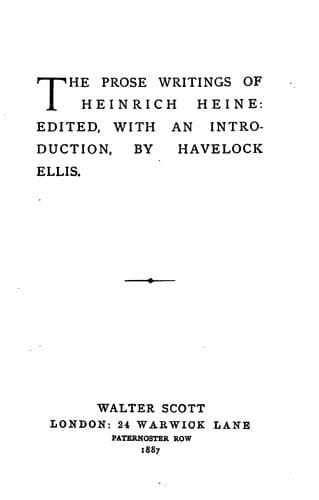
The Prose Writings of Heinrich HeineHeine, Heinrich
General
The Prose Writings of Heinrich Heine
Heine, Heinrich
Heine, Heinrich, 1797-1856 -- Translations into English
...Luther was not only the greatest, but also the most thoroughly German
hero of our history. In his character are combined, on the grandest
scale, all the virtues and all the faults of the Germans, so that, in
his own person, he was the representative of that wonderful Germany.
For he possessed qualities which we seldom find united, and which we
usually even consider to be irreconcilably antagonistic. He was
simultaneously a dreamy mystic and a practical man of action. His
thoughts possessed not only wings, but also hands; he could speak and
could act. He was not only the tongue, but also the sword of his time.
He was both a cold, scholastic word-caviller, and an enthusiastic,
God-inspired prophet. When, during the day, he had wearily toiled over
his dogmatic distinctions and definitions, then in the evening he took
his lute, looked up to the stars, and melted into melody and devotion.
The same man who could scold like a fish-wife could be as gentle as a
tender maiden. At times he was as fierce as the storm that uproots oaks;
and then again he was mild as the zephyr caressing the violets. He was
filled with a reverential awe of God. He was full of the spirit of
self-sacrifice for the honour of the Holy Ghost; he could sink his whole
personality in the most abstract spirituality, and yet he could well
appreciate the good things of this earth, and from his mouth blossomed
forth the famous saying--
"Who loves not wine, women, and song,
Will be a fool all his life long."
He was a complete man--I would say an absolute man, in whom spirit and
matter were not antagonistic. To call him a spiritualist would,
therefore, be as erroneous as to call him a sensualist. How shall I
describe him? He had in him something aboriginal, incomprehensible,
miraculous.
...All praise to Luther! Eternal honour to the blessed man to whom we
owe the salvation of our most precious possessions, and whose
benefactions we still enjoy. It ill becomes us to complain of the
narrowness of his views. The dwarf, standing on the shoulders of the
giant, particularly if he puts on spectacles, can, it is true, see
farther than the giant himself; but for noble thoughts and exalted
sentiments a giant heart is necessary. It were still more unseemly of us
to pass a harsh judgment on his faults, for those very faults have
benefited us more than the virtues of thousands of other men. The
refinement of Erasmus, the mildness of Melanchthon, could never have
brought us so far as the godlike brutality of Brother Martin.
Public-domain text, read in full here on John Shaqi.
Reviews
Reviews
No reviews yet
Be the first to share your thoughts on this work.
Elsewhere in the archive
Join the Discussion
Join the discussion
Sign in to leave a comment or review.
Sign InorCreate an account