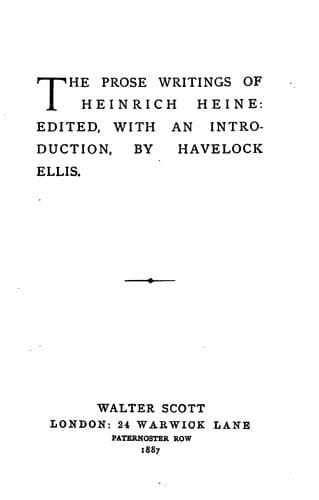
The Prose Writings of Heinrich HeineHeine, Heinrich
General
The Prose Writings of Heinrich Heine
Heine, Heinrich
Heine, Heinrich, 1797-1856 -- Translations into English
...From the day on which Luther denied the authority of the Pope, and
publicly declared in the Diet "that his teachings must be controverted
through the words of the Bible itself, or with sensible reasons," there
begins a new era in Germany. The fetters with which Saint Boniface had
chained the German Church to Rome are broken. This Church, which has
hitherto formed an integral part of the great hierarchy, now splits into
religious democracies. The character of the religion itself is
essentially changed: the Hindoo-Gnostic element disappears from it, and
the Judaic-theistic element again becomes prominent. We behold the rise
of evangelical Christianity. By recognising and legitimising the most
importunate claims of the senses, religion becomes once more a reality.
The priest becomes man, takes to himself a wife, and begets children, as
God desires.
...If in Germany we lost through Protestantism, along with the ancient
miracles, much other poetry, we gained manifold compensations. Men
became nobler and more virtuous. Protestantism was very successful in
effecting that purity of morals and that strictness in the fulfilment of
duty which is generally called morality. In certain communities, indeed,
Protestantism assumed a tendency which in the end became quite identical
with morality, and the gospels remained as a beautiful parable only.
Particularly in the lives of the ecclesiastics is a pleasing change now
noticeable. With celibacy disappeared also monkish obscenities and
vices. Among the Protestant clergy are frequently to be found the
noblest and most virtuous of men, such as would have won respect from
even the ancient Stoics. One must have wandered on foot, as a poor
student, through Northern Germany, in order to learn how much
virtue--and in order to give virtue a complimentary adjective, how much
evangelical virtue--is to be found in an unpretentious-looking
parsonage. How often of a winter's evening have I found there a
hospitable welcome,--I, a stranger, who brought with me no other
recommendation save that I was hungry and tired! When I had partaken of
a hearty meal, and, after a good night's rest, was ready in the morning
to continue my journey, then came the old pastor, in his dressing-gown,
and gave me a blessing on the way,--and it never brought me misfortune;
and his good-hearted, gossipy wife placed several slices of
bread-and-butter in my pocket, which I found not less refreshing; and
silent in the distance stood the pastor's pretty daughters, with
blushing cheeks and violet eyes, whose modest fire in the mere
recollection warmed my heart for many a whole winter's day.
Public-domain text, read in full here on John Shaqi.
Reviews
Reviews
No reviews yet
Be the first to share your thoughts on this work.
Elsewhere in the archive
Join the Discussion
Join the discussion
Sign in to leave a comment or review.
Sign InorCreate an account