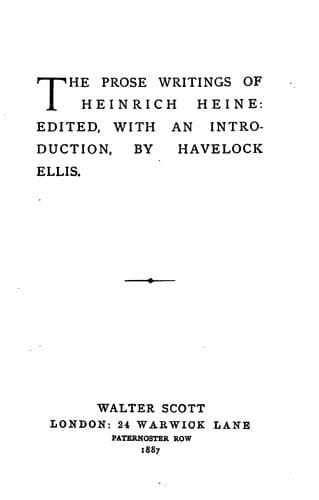
The Prose Writings of Heinrich HeineHeine, Heinrich
General
The Prose Writings of Heinrich Heine
Heine, Heinrich
Heine, Heinrich, 1797-1856 -- Translations into English
"He was not ugly. You see, we cannot answer affirmatively when anyone
asks us such a question about our own sex. He had a tall, slender
figure, which moved in an elegant, I might say a coquettish, manner;
always _a quatre épingles_; a long, regular face, with a pale rosiness;
very fair, almost golden, hair, put into small curls; very high noble
brows, a straight nose, pale blue eyes, a beautifully-chiselled mouth, a
round chin. His features had something vague and characterless;
something like milk, and in this milk-face often mingled, half sweet,
half bitter, an expression of sorrow. This expression of sorrow
compensated for the want of soul in Bellini's face, but it was a sorrow
without depth; it glistened in the eyes without poetry, it played
passionless about his lips. The young _Maestro_ seemed anxious to make
this flat, languid sorrow conspicuous in his whole person. His hair was
curled in such a fanciful, melancholy way, his clothes sat so languidly
about his frail body, he carried his little Spanish cane in so idyllic a
way, that he always reminded me of the affected young shepherds with
their be-ribboned sticks, and bright-coloured jackets, and pantaloons
that we see in our pastorals. And his gait was so young-lady-like, so
elegiac, so ethereal. The whole man looked like a sigh _en escarpins_.
He had received much applause among women, but I doubt if he anywhere
awakened a strong passion. In himself his appearance had something
comically unenjoyable, the reason of which lay in his way of speaking
French. Although Bellini had lived many years in France, he spoke the
language so badly, that even in England it could scarcely be spoken
worse. I ought not to call it 'bad;' bad is here much too good. One must
call it awful, a violation, something enough to overturn the world. Yes,
when one was in society with him, and he mangled the poor French words
like an executioner, and displayed, unmoved, his colossal _coq-à-l'âne_,
one thought sometimes that the world must fall in with a crash of
thunder. The stillness of the grave reigned on the whole room; a death
agony was painted on all faces in chalk or in vermilion; the ladies were
uncertain whether to faint or to escape; the gentlemen gazed in alarm at
their trousers, to convince themselves that they actually had them on;
and what was most horrible, this fright raised at the same time a
convulsive desire to laugh, which could hardly be suppressed. So that
when one was in Bellini's society, his presence inspired a certain
anxiety, which by a horrible charm was at once repellant and attractive.
Often his involuntary _calembours_ were merely amusing, and in their
droll insipidity reminded one of the castle of his fellow-countryman,
the Prince of Pallagonia, which Goethe in his _Italian Journey_ has
described as a museum of uncouth distortions and absurd deformities. As
Bellini on such occasions always imagined he had said something quite
Public-domain text, read in full here on John Shaqi.
Reviews
Reviews
No reviews yet
Be the first to share your thoughts on this work.
Elsewhere in the archive
Join the Discussion
Join the discussion
Sign in to leave a comment or review.
Sign InorCreate an account