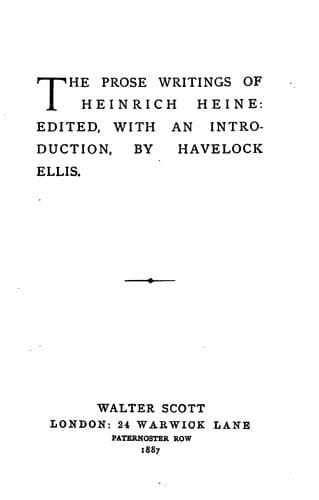
The Prose Writings of Heinrich HeineHeine, Heinrich
General
The Prose Writings of Heinrich Heine
Heine, Heinrich
Heine, Heinrich, 1797-1856 -- Translations into English
"Dance and dancer powerfully seized my attention. It was not the
classical dance which we still see in our great ballets, where, just as
in classical tragedy, only sprawling unities and artificialities reign;
it was not those danced Alexandrines, those declamatory springs, those
antithetic capers, that noble emotion which pirouets round on one foot,
so that one sees nothing except heaven and petticoats, ideality and
lies! There is, indeed, nothing so odious to me as the ballet at the
Paris Grand Opera, where the traditions of that classical dance are
retained in their purest forms, while in the rest of the arts, in
poetry, in music, and in painting, the French have overturned the
classical system. It will be, however, difficult for them to bring about
a similar revolution in the art of dancing; they will need, as in their
political revolution, to have recourse to terrorism, and guillotine the
legs of the obdurate dancers. Mademoiselle Laurence was no great dancer;
the joints of her feet were not very supple, her legs were not exercised
in all possible dislocations, she understood nothing of the art of
dancing as Madame Vestris teaches it, but she danced as nature commands
to dance: her whole being was in harmony with her _pas_; not only her
feet but her whole body danced; her face danced--she was often pale,
almost deathly pale, her eyes opened to an almost ghostly size, desire
and pain quivered on her lips, and her black hair, which enclosed her
brows in smooth oval, moved like a pair of fluttering wings. It was,
indeed, no classical dance, but also no romantic dance, in the sense of
a young Frenchman of the Eugène Renduel school. This dance had nothing
mediæval, nor Venetian, nor hump-backed, nor Macabrian about it; there
was neither moonshine nor incest in it. It was a dance which did not
seek to answer by outward movements, but the outward movements seemed
words of a strange speech which strove to express strange things. But
what did this dance express? I could not understand, however
passionately this speech uttered itself. I only guessed sometimes that
it spoke of something intensely sorrowful. I, who so easily seized the
meaning of all appearances, was nevertheless unable to solve this danced
riddle; and that I groped in vain for the sense of it was partly the
fault of the music, which certainly pointed intentionally to false
roads, cunningly sought to lead me astray, and always disturbed me.
Monsieur Turlutu's triangle often tittered maliciously. Madame, however,
beat upon her drum so wrathfully, that her face glowed forth from the
black cloud of cap like a blood-red northern light.
Public-domain text, read in full here on John Shaqi.
Reviews
Reviews
No reviews yet
Be the first to share your thoughts on this work.
Elsewhere in the archive
Join the Discussion
Join the discussion
Sign in to leave a comment or review.
Sign InorCreate an account