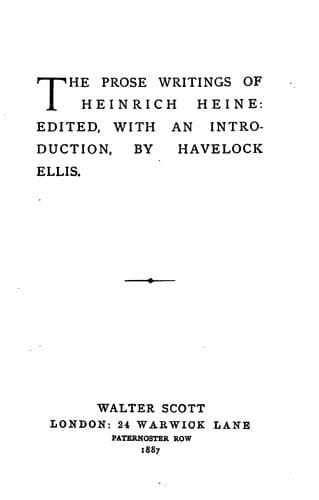
The Prose Writings of Heinrich HeineHeine, Heinrich
General
The Prose Writings of Heinrich Heine
Heine, Heinrich
Heine, Heinrich, 1797-1856 -- Translations into English
"This thirst to enjoy life, as if death was about to snatch them from
the bubbling spring of enjoyment, or as if that spring was about to
cease flowing, this haste, this fury, this madness of the Parisian
women, especially as it shows itself at balls, reminds me always of the
legend of the dead dancing-girls which we call Willis. These are young
brides who died before the wedding-day, and the unsatisfied desire of
dancing is preserved so powerfully in their hearts that they come every
night out of their graves, assemble in bands on the high roads, and give
themselves up at midnight to the wildest dances. Dressed in their
wedding clothes, with garlands on their heads, and glittering rings on
their pale hands, laughing horribly, irresistibly lovely, the Willis
dance in the moonshine, and they dance ever more madly the more they
feel that the hour of dancing, which has been granted them, is coming to
an end, and that they must again descend to their cold graves.
"At a soirée once in the Chaussée d'Antin this idea moved my soul
profoundly. It was a brilliant soirée, and none of the customary
ingredients of social pleasure were wanting: enough light to illuminate
us, enough mirrors to see ourselves in, enough people to heat us with
the squeeze, enough _eau sucrée_ to cool us. They began with music.
Franz Liszt allowed himself to be drawn to the piano, pushed his hair
over his genial brows, and waged one of his most brilliant battles. The
keys seemed to bleed. If I am not mistaken, he played a passage from the
_Palingenesis_ of Ballanche, whose ideas he was translating into music,
which was very useful for those who cannot read the works of that famous
writer in the original. Afterwards he played Berlioz's _La Marche au
Supplice_, that excellent piece which the young musician, if I am not
mistaken, composed on the morning of his wedding-day. Throughout the
room paled faces, heaving bosoms, highly-drawn breath during the pauses,
were succeeded at last by stormy applause. The women are always as it
were intoxicated when Liszt plays anything for them. The Willis of the
_salon_ now gave themselves up to dancing with frantic delight, and I
had difficulty in getting out of this confusion and saving myself in the
adjoining room. Here card-playing was going on, and several ladies were
resting in large chairs, looking on at the players, or at all events
pretending to interest themselves in the play. As I passed one of these
ladies, and my arm touched her dress, I felt from hand to shoulder a
slight quiver as from a very weak electric shock. A similar shock, but
of the greatest force, went through my whole heart when I saw the lady's
countenance. Was it she, or was it not? It was the same face, with the
form and sunny colour of an antique, only it was no longer so marble
pure and marble smooth as formerly. The acute observer might perceive
on brow and cheeks several little flaws, perhaps small-pox marks, which
Public-domain text, read in full here on John Shaqi.
Reviews
Reviews
No reviews yet
Be the first to share your thoughts on this work.
Elsewhere in the archive
Join the Discussion
Join the discussion
Sign in to leave a comment or review.
Sign InorCreate an account