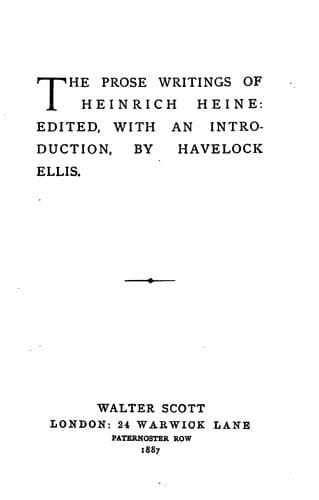
The Prose Writings of Heinrich HeineHeine, Heinrich
General
The Prose Writings of Heinrich Heine
Heine, Heinrich
Heine, Heinrich, 1797-1856 -- Translations into English
"I do not mean anything wicked by this observation, certainly not as
regards the French ladies, and least of all as regards the Parisian
ladies. I am their greatest adorer, and I adore them on account of their
failings still more than on account of their virtues. I know nothing
more excellent than the legend that the Parisian women come into the
world with all possible failings, but that a kind fairy has mercy upon
them and lends to each fault a spell by which it works as a charm. That
kind fairy is Grace! Are the Parisian women beautiful? Who can say? Who
can see through all the intrigues of the toilet? Who can decipher
whether what the tulle betrays is genuine, or what the swelling silk
displays, false? And when the eye succeeds in piercing the shell, and we
are at the point of finding the kernel, we discover that it is enclosed
in a new shell, and after this again in another, and with this ceaseless
change of fashions they mock masculine acuteness. Are their faces
beautiful? Even this is difficult to find out. For all their features
are in constant movement; every Parisian woman has a thousand faces,
each more laughing, _spirituel_, gracious than the other, and puts to
confusion those who seek to choose the loveliest face among them, or at
all events, who wishes to guess which is the true face. Are their eyes
large? What do I know! We cease investigating the calibre of the canon
when the ball carries off our heads. And when their eyes do not hit,
they at least blind us with the flash, and we are glad enough to get out
of range. Is the space between nose and mouth broad or narrow? It is
often broad when they wrinkle up their noses; it is often narrow when
they give their upper lips an insolent little pout. Have they large or
small mouths? Who can say where the mouth leaves off and where the smile
begins? In order to give a just opinion, both the observer and the
object of observation must be in a state of rest. But who can be quiet
near a Parisian, and what Parisian woman is ever quiet? There are people
who think that they can observe a butterfly quite accurately when they
have stuck it on to paper with a pin. That is as foolish as it is cruel.
The motionless transfixed butterfly is a butterfly no longer. One must
observe the butterfly in his antics round the flowers, and one must
observe the Parisian woman, not at home, when she is made fast by a pin
through her breast, but in the _salon_, at soirées, and balls, when she
flutters about with her wings of gauze and silk beneath the gleaming
chandeliers. Then is revealed in her an impetuous passion for life, a
longing after a sweet stupor, a thirsting for intoxication, by which
means she becomes almost horribly beautiful, and wins a charm which at
the same time delights and terrifies our souls.
Public-domain text, read in full here on John Shaqi.
Reviews
Reviews
No reviews yet
Be the first to share your thoughts on this work.
Elsewhere in the archive
Join the Discussion
Join the discussion
Sign in to leave a comment or review.
Sign InorCreate an account