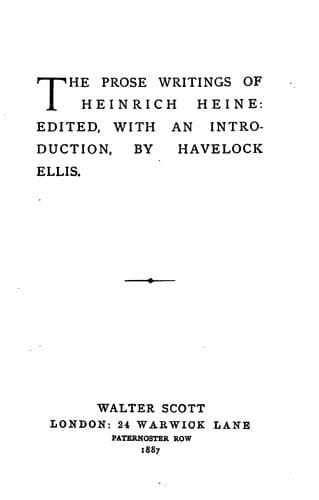
The Prose Writings of Heinrich HeineHeine, Heinrich
General
The Prose Writings of Heinrich Heine
Heine, Heinrich
Heine, Heinrich, 1797-1856 -- Translations into English
"Remain lying still," replied Maximilian. "I have seen them all again,
even the learned dog. The poor rascal was certainly in a very sad state
of necessity when I came across him at Paris. It was in the Quartier
Latin. I had just passed the Sorbonne, when out of its gates rushed a
dog, and behind him with sticks a dozen students, who were soon joined
by two dozen old women, who all cried in chorus, 'The dog is mad!' The
animal looked almost human in his death agony, tears flowed from his
eyes, and as he ran panting by and lifted his moist glance towards me, I
recognised my old friend the learned dog, the Duke of Wellington's
panegyrist, who had once filled the people of England with wonderment.
Was he really mad? Had he been driven mad by mere learning while
pursuing his studies in the Quartier Latin? Or had he in the Sorbonne,
by his growling and scratching, marked his disapprobation of the
puffed-up charlatanry of some professor, who sought to free himself from
his unfavourable hearer by proclaiming him to be mad? And, alas! the
youths are not long investigating whether it is the wounded conceit of
learning or envy that first called out, 'The dog is mad!' and they
strike with their thoughtless sticks, and the old women are ready with
their howling, and cry down the voice of innocence and reason. My poor
friend must yield; before my eyes he was miserably struck to death,
insulted, and at last thrown on a dunghill! Poor martyr of learning!
"Not much more pleasant was the condition of the dwarf, Monsieur
Turlutu, when I found him on the Boulevard du Temple. Mademoiselle
Laurence had certainly told me that he had gone there, but whether I had
not thought of actually seeing him there, or that the crowd had hindered
me, it was some time before I noted the place where the giants were to
be seen. When I entered I found two tall fellows who lay idly on
benches, and quickly sprang up and placed themselves in giant posture
before me. They were, in truth, not as large as they boasted on the
placards hanging outside. These two long fellows, who were dressed in
pink _tricots_, had very black, perhaps false, whiskers, and brandished
hollow wooden clubs over their heads. When I asked after the dwarf, whom
the placards also announced, they replied that for four weeks he had not
been exhibited on account of his increasing illness--that I could see
him, however, on paying double the price of admission. How willingly one
pays double admission-fee to see a friend again! And, alas, this was a
friend who lay on his death-bed. This death-bed was properly a cradle,
and the poor dwarf lay inside with his yellow shrivelled old face. A
little girl of some fourteen years sat beside him, and rocked the cradle
with her foot, and sang in a laughing, roguish tone--
"'Sleep, little Turlutu, sleep!'
Public-domain text, read in full here on John Shaqi.
Reviews
Reviews
No reviews yet
Be the first to share your thoughts on this work.
Elsewhere in the archive
Join the Discussion
Join the discussion
Sign in to leave a comment or review.
Sign InorCreate an account