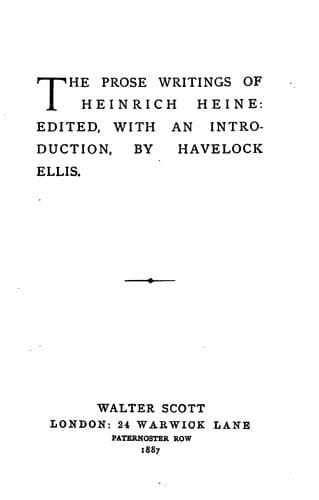
The Prose Writings of Heinrich HeineHeine, Heinrich
General
The Prose Writings of Heinrich Heine
Heine, Heinrich
Heine, Heinrich, 1797-1856 -- Translations into English
Verily, society is republican in its very essence. Every sovereignty,
intellectual as well as material, is hated by it. The latter oftener
gives aid to the former than is generally imagined. We ourselves came to
this conclusion soon after the revolution of July, when the spirit of
republicanism manifested itself in all social relations. Our republicans
hated the laurels of a great poet even as they hated the purple of a
great king. They sought to level the intellectual inequalities of
mankind, and in as much as they regarded all ideas that had been
produced on the soil of the state as general property, nothing remained
to be done but to decree an equality of style also. In sooth, a good
style was decried as something aristocratic, and we heard manifold
assertions: "A true democrat must write in the style of the
people--sincere, natural, crude." Most of the Party of Action succeeded
easily in doing this, but not every one possesses the gift of writing
badly, especially if one has previously formed the habit of writing
well, and then it was at once said, "That is an aristocrat, a lover of
style, a friend of art, an enemy of the people." They were surely honest
in their views, like Saint Hieronymus, who considered his good style a
sin, and gave himself sound scourgings for it.
Just as little as we find anti-Catholic, so also do we fail to discover
anti-absolutist strains in _Don Quixote_. The critics who think that
they scent such sentiments therein are clearly in error. Cervantes was
the son of a school which went so far as to poetically idealise the idea
of unquestioning obedience to the sovereign. And that sovereign was the
King of Spain at a time when its majesty dazzled the whole world. The
common soldier felt himself a ray in that halo of glory, and willingly
sacrificed his individual freedom to gratify the national pride of the
Castilian.
The political grandeur of Spain at that time contributed not a little to
exalt and enlarge the hearts of her poets. In the mind of a Spanish
poet, as in the realm of Charles V., the sun never set. The fierce wars
against the Moors were ended, and as after a storm the flowers are most
fragrant, so poesy ever blooms most grandly after a civil war. We
witness the same phenomenon in England at the time of Elizabeth, and at
the same time as in Spain there arose a galaxy of poets, which invites
the most remarkable parallelisms. There we see Shakespeare, here
Cervantes, as the flower of the school.
Like the Spanish poets under the three Philips, so also the English
poets under Elizabeth present a certain family likeness, and neither
Shakespeare nor Cervantes have claim to originality in our sense of the
word. They by no means differ from their contemporaries through peculiar
modes of thought or feeling, or by an especial manner of portrayal, but
only through greater depth, fervour, tenderness, and power. Their
creations are more infused and penetrated with the divine spark of
poetry.
Public-domain text, read in full here on John Shaqi.
Reviews
Reviews
No reviews yet
Be the first to share your thoughts on this work.
Elsewhere in the archive
Join the Discussion
Join the discussion
Sign in to leave a comment or review.
Sign InorCreate an account