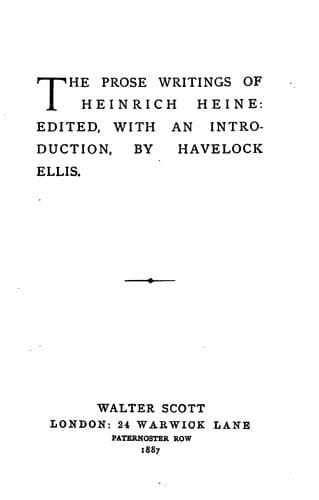
The Prose Writings of Heinrich HeineHeine, Heinrich
General
The Prose Writings of Heinrich Heine
Heine, Heinrich
Heine, Heinrich, 1797-1856 -- Translations into English
But both poets were not only the flowers of their time, but they were
also the germs of the future. As Shakespeare, by the influence of his
works, particularly on Germany and the France of to-day, is to be
regarded as the creator of the later dramatic art, so must we honour in
Cervantes the author of the modern novel. I shall allow myself a few
passing observations on the subject.
The older novels, the so-called romances of chivalry sprang from the
poetry of the middle ages. They were at first prose versions of those
epic poems whose heroes are derived from the mythical traditions of
Charlemagne and the Holy Grail. The subject was always knightly
adventures. It was the romance of the nobility, and the personages that
figured therein were either fabulous, fantastic beings, or knights with
golden spurs; nowhere an allusion to the people. These romances of
knighthood, which degenerated into the most ridiculous absurdities,
Cervantes overthrew by his _Don Quixote_. But while by his satire he
destroyed the earlier romances, he also furnished a model for a new
school of fiction, which we call the Modern Novel. Such is always the
wont of great poets; while they tear down the old, they at the same time
build up the new; they never destroy without replacing. Cervantes
created the modern novel by introducing into his romances of knighthood
a faithful description of the lower classes, by intermingling with it
phases of folk-life. This partiality for describing the doings of the
common rabble, of the vilest tatterdemalions, is not only found in
Cervantes, but in all his literary contemporaries, and among the Spanish
painters as well as among the poets of that period. A Murillo, who stole
heaven's loveliest tints with which to paint his beautiful Madonnas,
painted with the same love the filthiest creatures of this earth. It was
perhaps the enthusiasm for art itself that made these noble Spaniards
find equal pleasure in the faithful portrayal of a beggar lad scratching
his head as in the representation of the Blessed Virgin. Or, perhaps, it
was the charm of contrast that led noblemen of the highest rank, a
dapper courtier like Quevedo, or a powerful minister like Mendoza, to
fill their romances with ragged beggars and vagabonds. They perhaps
sought to relieve the monotony of their lofty rank by putting
themselves in imagination into a quite different sphere of life, just as
we find a similar tendency among some of our German authors, whose
novels contain naught else but descriptions of the nobility, and who
always make their heroes counts and barons. We do not find in Cervantes
this one-sided tendency to portray the vulgar only; he intermingles the
ideal and the common; one serves as light or as shade to the other, and
the aristocratic element is as prominent in it as the popular. But this
noble, chivalrous, aristocratic element disappears entirely from the
novels of the English, who were the first to imitate Cervantes, and to
Public-domain text, read in full here on John Shaqi.
Reviews
Reviews
No reviews yet
Be the first to share your thoughts on this work.
Elsewhere in the archive
Join the Discussion
Join the discussion
Sign in to leave a comment or review.
Sign InorCreate an account