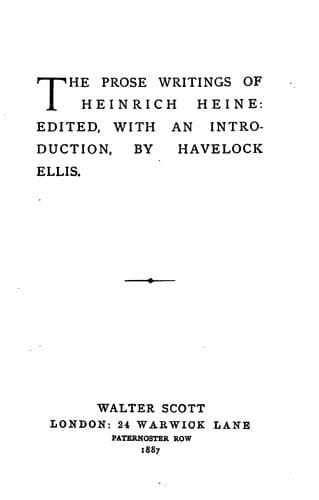
The Prose Writings of Heinrich HeineHeine, Heinrich
General
The Prose Writings of Heinrich Heine
Heine, Heinrich
Heine, Heinrich, 1797-1856 -- Translations into English
My remarks concerning the genius of Cervantes and the influence of his
book have been necessarily scant. Concerning the true value of his
romance from an artistic standpoint, I must express myself still more
briefly, as otherwise questions might arise which would lead to wide
digressions into the sphere of æsthetics. I may only call attention in a
general way to the form of the romance, and to the two figures that
constitute its central point. The form is that of a description of
travels which has ever been the most natural for this class of writings.
I am reminded of The Golden Ass of Apuleius, the first romance of
antiquity. Later poets sought to relieve the monotony of this form
through what we to-day call _fabliaux_. But on account of poverty of
invention the majority of romance writers have borrowed each other's
fables; at least, part have always used the same tales, making but
slight variations. Hence, through the resulting sameness of characters,
situations, and complications, the public became at last somewhat
wearied of romance-reading. To escape from the tediousness of hackneyed
tales and fables, they sought refuge in the ancient, original form of
narratives of travels. But this form will again be wholly supplanted
just as soon as some creative genius shall arise with a new and original
style of romance. In literature, as well as in politics, all things are
subject to the law of action and reaction.
As regards the two figures that are called Don Quixote and Sancho Panza,
that so constantly burlesque, and yet so wonderfully complement each
other, so that together they form the one true hero of the
romance,--these two figures give evidence equally of the poet's artistic
taste and of his intellectual profundity. If other authors, in whose
romances the hero journeys solitary and alone through the world, are
compelled to have recourse to monologues, letters, or diaries in order
to communicate the thoughts and emotions of their heroes, Cervantes can
always let a natural dialogue arise; and, inasmuch as the one figure
always parodies the other, the author's purpose is the more clearly
shown. Manifold have been the imitations of this double figure which
lends to the romance of Cervantes such an artistic naturalness, and out
of which, as from a single seed, has grown the whole novel, with all its
wild foliage, its fragrant blossoms, its glowing fruits, its apes and
marvellous birds that cluster amid its branches, resembling one of those
giant trees of India.
Public-domain text, read in full here on John Shaqi.
Reviews
Reviews
No reviews yet
Be the first to share your thoughts on this work.
Elsewhere in the archive
Join the Discussion
Join the discussion
Sign in to leave a comment or review.
Sign InorCreate an account