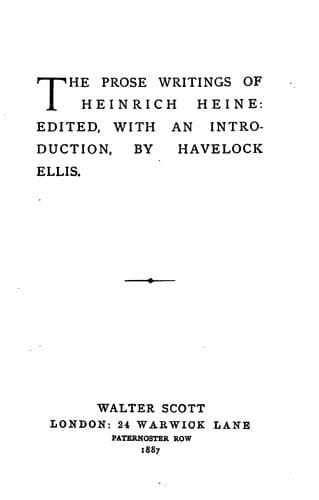
The Prose Writings of Heinrich HeineHeine, Heinrich
General
The Prose Writings of Heinrich Heine
Heine, Heinrich
Heine, Heinrich, 1797-1856 -- Translations into English
Cervantes, Shakespeare, and Goethe form the triumvirate of poets, who,
in the three great divisions of poetry, epic, dramatic, and lyric, have
achieved the greatest success. The writer of these pages is perhaps
peculiarly fitted to sound the praises of our great countryman as the
most perfect of lyric poets. Goethe stands midway between the two
classes of song-writers, between those two schools, of which one, alas!
is known by my own name, the other as the Suabian school. Both have
their merits; they have indirectly promoted the welfare of German
poetry. The first effected a wholesome reaction against the one-sided
idealism of German poetry, it led the intellect back to stern realities,
and uprooted that sentimental Petrarchism that has always seemed to us
as a Quixotism in verse. The Suabian school also contributed indirectly
to the weal of German poetry. If in Northern Germany strong and healthy
poetical productions came to light, thanks are perhaps due to the
Suabian school, which attracted to itself all the sickly chlorotic,
mawkishly-pious, clumsy votaries of the German muse. Stuttgart was the
fontanel, as it were, for the German muse.
While I ascribe the highest achievements in drama, in romance, and in
lyric poetry to this great triumvirate, far be it from me to depreciate
the poetical merits of other great poets. Nothing is more foolish than
the query, "Which poet is greater than the other?" Flame is flame, and
its weight cannot be determined in pounds and ounces. Only a narrow
shopkeeper mind will attempt to weigh genius in its miserable cheese
scales. Not only the ancients, but some of the moderns, have written
works in which the fire of poetry burns with a splendour equal to that
of the masterpieces of Shakespeare, Cervantes, and Goethe. Nevertheless,
these names hold together as if through some secret bond. A kindred
spirit shines forth from their creations, an immortal tenderness
exhales from them like the breath of God, the modesty of nature blooms
in them. Goethe not only constantly reminds one of Shakespeare, but also
of Cervantes, and he resembles the latter even in the details of style,
and in that charming prose diction which is tinged with a vein of the
sweetest and most harmless irony. Cervantes and Goethe resemble each
other even in their faults, in diffusiveness of style, in those long
sentences that we occasionally find in their writings, and which may be
compared to a procession of royal equipages. Not infrequently but a
single thought sits in one of those long, wide-spreading sentences that
rolls majestically along like a great, gilded court-chariot, drawn by
six plumed steeds. But that single idea is always something exalted,
perhaps even royal.
Public-domain text, read in full here on John Shaqi.
Reviews
Reviews
No reviews yet
Be the first to share your thoughts on this work.
Elsewhere in the archive
Join the Discussion
Join the discussion
Sign in to leave a comment or review.
Sign InorCreate an account