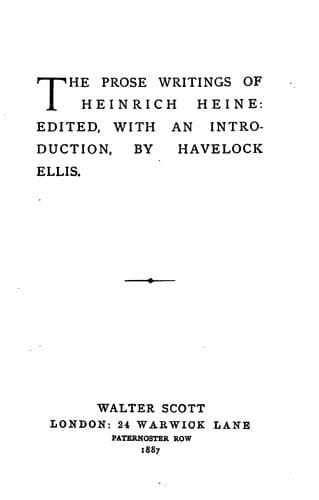
The Prose Writings of Heinrich HeineHeine, Heinrich
General
The Prose Writings of Heinrich Heine
Heine, Heinrich
Heine, Heinrich, 1797-1856 -- Translations into English
A witty Frenchman--a few years ago these words would have been a
pleonasm--once dubbed me an unfrocked Romanticist. I have a weakness for
all that is witty; and spiteful as was this appelation, it nevertheless
delighted me highly. Notwithstanding the war of extermination that I had
waged against Romanticism, I always remained a Romanticist at heart, and
that in a higher degree than I myself realised. After I had delivered
the most deadly blows against the taste for Romantic poetry in Germany,
there stole over me an inexpressible yearning for the blue flower in the
fairy-land of Romanticism, and I grasped the magic lyre and sang a song
wherein I gave full sway to all the sweet extravagances, to all the
intoxication of moonlight, to all the blooming, nightingale-like fancies
once so fondly loved. I know it was "the last free-forest song of
Romanticism,"[15] and I am its last poet. With me the old German lyric
school ends; while with me, at the same time, the modern lyric school of
Germany begins. Writers on German literature will assign to me this
double rôle. It would be unseemly for me to speak at length on this
subject, but I may with justice claim a liberal space in the history of
German Romanticism. For this reason I ought to have included in my
account of the Romantic school a review of my own writings. By my
omission to do this, a gap has been left which I cannot easily fill. To
write a criticism of one's self is an embarrassing, even an impossible
task. I should be a conceited coxcomb to obtrude the good I might be
able to say of myself, and I should be a great fool to proclaim to the
whole world the defects of which I might also be conscious. And even
with the most honest desire to be sincere, one cannot tell the truth
about oneself. No one has as yet succeeded in doing it, neither Saint
Augustine, the pious bishop of Hippo, nor the Genevese Jean Jacques
Rousseau--least of all the latter, who proclaimed himself the man of
truth and nature, but was really much more untruthful and unnatural than
his contemporaries.
...Rousseau, who in his own person also slandered human nature, was yet
true to it in respect to our primitive weakness, which consists in
always wishing to appear in the eyes of the world as something different
from what we really are. His self-portraiture is a lie, admirably
executed, but still only a brilliant lie.
Public-domain text, read in full here on John Shaqi.
Reviews
Reviews
No reviews yet
Be the first to share your thoughts on this work.
Elsewhere in the archive
Join the Discussion
Join the discussion
Sign in to leave a comment or review.
Sign InorCreate an account