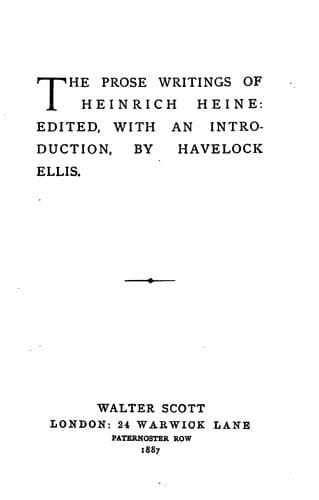
The Prose Writings of Heinrich HeineHeine, Heinrich
General
The Prose Writings of Heinrich Heine
Heine, Heinrich
Heine, Heinrich, 1797-1856 -- Translations into English
...But, on the other hand, I think I may flatter myself that I can
better comprehend, in the first part of the holy book, the character of
Moses. His grand figure has impressed me not a little. What a colossal
form! I cannot imagine that Og, King of Bashan, could have looked more
giant-like. How insignificant does Sinai appear when Moses stands
thereon! That mountain is merely a pedestal for the feet of the man
whose head towers in the heavens and there holds converse with God. May
God forgive the sacrilegious thought! but sometimes it appears to me as
if this Mosaic God were only the reflected radiance of Moses himself,
whom he so strongly represents in wrath and in love. It were a sin, it
were anthropomorphism, to assume such an identity of God and his
prophet; but the resemblance is most striking.
I had not previously much admired the character of Moses, probably
because the Hellenic spirit was predominant in me, and I could not
pardon the lawgiver of the Jews for his hate of the plastic arts. I
failed to perceive that Moses, notwithstanding his enmity to art, was
nevertheless himself a great artist, and possessed the true artistic
spirit. Only, this artistic spirit with him, as with his Egyptian
countrymen, was applied to the colossal and the imperishable. But not,
like the Egyptians, did he construct his works of art from bricks and
granite, but he built human pyramids and carved human obelisks. He took
a poor shepherd tribe and from it created a nation which should defy
centuries; a great, an immortal, a consecrated race, a God-serving
people, who to all other nations should be as a model and prototype: he
created Israel.
I have never spoken with proper reverence either of the artist or of his
work, the Jews; and for the same reason--namely, my Hellenic
temperament, which was opposed to Jewish asceticism. My prejudice in
favour of Hellas has declined since then. I see now that the Greeks were
only beautiful youths, but that the Jews were always men, strong,
unyielding men, not only in the past, but to this very day, in spite of
eighteen centuries of persecution and suffering. Since that time I have
learned to appreciate them better, and, were not all pride of ancestry a
silly inconsistency in a champion of the revolution and its democratic
principles, the writer of these pages would be proud that his ancestors
belonged to the noble house of Israel, that he is a descendant of those
martyrs who gave the world a God and a morality, and who have fought and
suffered on all the battle-fields of thought.
Public-domain text, read in full here on John Shaqi.
Reviews
Reviews
No reviews yet
Be the first to share your thoughts on this work.
Elsewhere in the archive
Join the Discussion
Join the discussion
Sign in to leave a comment or review.
Sign InorCreate an account