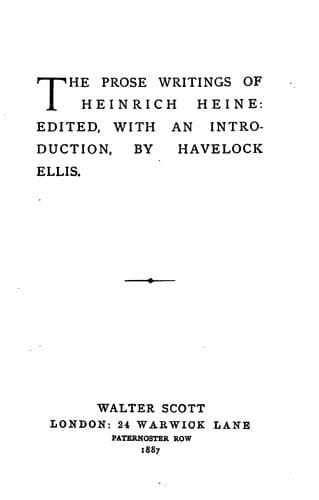
The Prose Writings of Heinrich HeineHeine, Heinrich
General
The Prose Writings of Heinrich Heine
Heine, Heinrich
Heine, Heinrich, 1797-1856 -- Translations into English
Now that my physical sufferings, and the reawakening of my religious
nature, have effected in me many changes, does the uniform of
Lutheranism in some measure express my true sentiments? How far has the
formal profession become a reality? I do not propose to give direct
answers to these questions, but I shall avail myself of the opportunity
to explain the services which, according to my present views,
Protestantism has rendered to civilisation. From this may be inferred
how much more I am now in sympathy with this creed.
At an earlier period, when philosophy possessed for me a paramount
interest, I prized Protestantism only for its services in winning
freedom of thought, which, after all, is the foundation on which in
later times Leibnitz, Kant, and Hegel could build. Luther, the strong
man with the axe, must, in the very nature of things, have preceded
these warriors, to open a path for them. For this service I have
honoured the Reformation as being the beginning of German philosophy,
which justified my polemical defence of Protestantism. Now, in my later
and more mature days, when the religious feeling again surges up in me,
and the shipwrecked metaphysician clings fast to the Bible,--now I
chiefly honour Protestantism for its services in the discovery and
propagation of the Bible. I say "discovery," for the Jews, who had
preserved the Bible from the great conflagration of the sacred temple,
and all through the middle ages carried it about with them like a
portable fatherland, kept their treasure carefully concealed in their
ghettos. Here came by stealth German scholars, the predecessors and
originators of the Reformation, to study the Hebrew language and thus
acquire the key to the casket wherein the precious treasure was
enclosed. Such a scholar was the worthy Reuchlinus; and his enemies, the
Hochstraaten, in Cologne, who are represented as the party of darkness
and ignorance, were by no means such simpletons. On the contrary, they
were far-sighted Inquisitors, who foresaw clearly the disasters which a
familiar acquaintance with the Holy Scriptures would bring on the
Church. Hence the persecuting zeal with which they sought to destroy the
Hebrew writings, at the same time inciting the rabble to exterminate the
Jews, the interpreters of these writings. Now that the motives of their
actions are known, we see that, properly considered, each was in the
right. This reactionary party believed that the spiritual salvation of
the world was endangered, and that all means, falsehood as well as
murder, were justifiable, especially against the Jews. The lower
classes, pinched by poverty, and heirs of the primeval curse, were
embittered against the Jews because of the wealth they had amassed; and
what to-day is called the hate of the proletariate against the rich, was
then called hate against the Jews. In fact, as the latter were excluded
from all ownership of land and from every trade, and relegated to
Public-domain text, read in full here on John Shaqi.
Reviews
Reviews
No reviews yet
Be the first to share your thoughts on this work.
Elsewhere in the archive
Join the Discussion
Join the discussion
Sign in to leave a comment or review.
Sign InorCreate an account