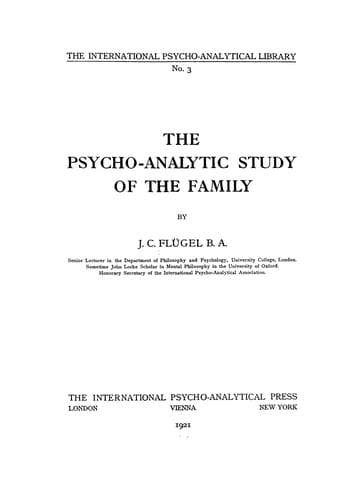
The psycho-analytic study of the familyFlugel, J. C. (John Carl)
Science
The psycho-analytic study of the family
Flugel, J. C. (John Carl)
Families; Marriage; Parent and child; Psychoanalysis
In studying the hate aspects of the original Œdipus complex we saw that
these aspects, on their first appearance and in so far as they depend on
mere jealousy or envy, are secondary products, arising as a consequence
of the love aspects. When the cause of the jealousy is removed by a
successful displacement of the love impulse, there is no longer any reason
for the continuance of the hate. It is probably for this reason that
the displacements of the hate aspects appear to be, on the whole, less
numerous and less complicated than those of the love aspects.
Certain forms of love displacement, it is true, necessarily imply, to
some extent, correlative forms of hate displacement; as in the case
(studied in the last chapter) of the transfer of love exclusively to
married or betrothed persons or in the case of the rescue phantasy. In
these cases the rival with whom the lover competes for the possession of
the loved object or the tyrant from whose clutches the captive lady is
snatched by the skill or daring of the youthful hero, are (in the light of
psycho-analytic knowledge) manifest substitutes for the original rival or
tyrant who existed in the person of the father. The intensity of hostile
feeling of which these representatives become the objects may however
vary very considerably from one instance to another, according as the
emphasis of the whole phantasy is laid upon the elements of hatred or
of love. Sometimes the hostile rival may be present only in a vague and
shadowy form, constituting little more than a necessary background; as,
for instance, in cases where the existence of some kind of opposition is
essential to the arousal or enjoyment of love. In other cases, however,
the hate element may be equal in importance to the love element, or may
even constitute the predominant motive of the whole displacement.
[Sidenote: The development of hate]
In these latter cases it will usually be found that the hostility
brought about secondarily as the result of jealousy has been powerfully
reinforced by hatred of a more direct and independent kind, arising as a
reaction against a more general interference with the child's aspirations
or desires on the part of a tyrannous parental authority (or one that
is considered to be such). The presence, in some degree, of this form
of reaction is very prevalent, and this is not surprising when we bear
in mind the fact that the child has, during its early years, to be
continually moderated, guided, stimulated or restrained in its actions, or
tendencies to action, by the exercise of parental or of delegated parental
authority[140].
Public-domain text, read in full here on John Shaqi.
Reviews
Reviews
No reviews yet
Be the first to share your thoughts on this work.
Elsewhere in the archive
Join the Discussion
Join the discussion
Sign in to leave a comment or review.
Sign InorCreate an account