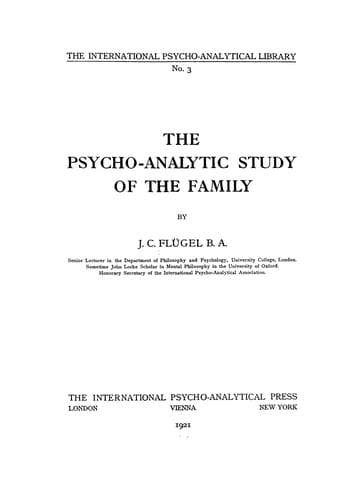
The psycho-analytic study of the familyFlugel, J. C. (John Carl)
Science
The psycho-analytic study of the family
Flugel, J. C. (John Carl)
Families; Marriage; Parent and child; Psychoanalysis
The exercise of such restraint or guidance, even within necessary and
desirable limits and with all the care, refinement and regard to the
child's own natural course of development which modern methods of training
may dictate, is bound to give rise to _some_ feeling of resentment,
especially in children of self-willed, obstinate or independent character
or in those with whom the tendencies in need of guidance or restraint are
unusually vigorous or persistent. Much more so even is this liable to be
the case where (as may often happen) the child's upbringing is carried
out with but little regard for, or understanding of, its own feelings,
susceptibilities or tendencies. In all such cases the hostile sentiments
aroused by the conflict of parental authority with the impetuous desires
of childhood may be such as to outlast the period of early life to
which they properly belong and to furnish a basis for a pathological
fixation at the stage of parent-hatred, as a result of which this hatred
may constitute an important--and usually maleficent--component of the
individual's character throughout his life.
[Sidenote: Displacement of hate on to parent substitutes]
We have already, in the earlier chapters, discussed the manner in which
parent hatred of early origin (together with most other aspects of the
young child's attitude towards its parents) should, in the course of
normal development, be overcome. We have already seen, however, that
certain of the secondary hatreds consequent upon incestuous love are in
many individuals incapable of being completely and satisfactorily resolved
in any of the normal ways, but become, instead, displaced on to parent
substitutes in the same way as the love impulses which they accompany.
The same fate of displacement awaits, in most cases, those more direct
and primary hatreds which are consequent upon the parent's interference
with the child's more general wishes and desires. In the course of the
individual's life, the authority over his expressions, activities and
general mode of living originally exercised by the parents, passes in
succession, wholly or partly, to a number of other persons; to whom
the feelings directed to the parents in virtue of the exercise of this
authority is then transferred. Among those to whom such transference most
frequently and regularly takes place are to be found--nurses, teachers,
school prefects, police officers, employers, professional or military
superiors, or persons occupying general positions of command, such as
magistrates, statesmen or kings.
[Sidenote: This displacement may lead to rebellion against authority and
the persons who exercise it]
Public-domain text, read in full here on John Shaqi.
Reviews
Reviews
No reviews yet
Be the first to share your thoughts on this work.
Elsewhere in the archive
Join the Discussion
Join the discussion
Sign in to leave a comment or review.
Sign InorCreate an account