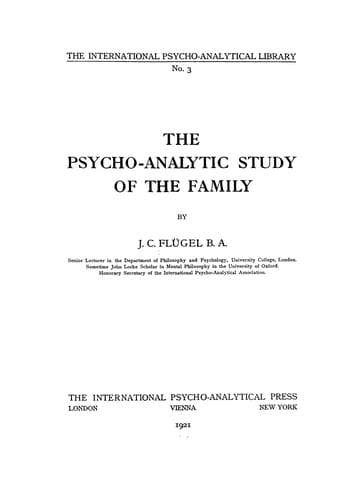
The psycho-analytic study of the familyFlugel, J. C. (John Carl)
Science
The psycho-analytic study of the family
Flugel, J. C. (John Carl)
Families; Marriage; Parent and child; Psychoanalysis
Where the attitude towards the state, its institutions and authority
is not one of love, friendliness or reverence, but one of hate and
rebellion, it is of course the corresponding feelings of hostility towards
the parents which play a leading part in the unconscious motivation of
malcontents or revolutionaries. It is principally for this reason that
revolutions in autocratic paternal states (_cp._ the recent upheavals in
Russia and Germany and the French Revolution) are usually more violent and
extreme than in the case of the freer and more liberal maternal countries,
since the desire for rebellion in early family life is generally directed
against the authority of the father to a much greater extent than against
that of the mother.
[Sidenote: Family organisation and State organisation]
There probably exists, moreover, as Rank[154] and Jones[155] have already
suggested, a considerable degree of correspondence between the nature
of the family system as found in any country and some of the political
features to which we have referred. Thus the authority of the head of the
household--the _patria potestas_--was perhaps more developed among the
Romans than among any other western people, and the Romans elaborated a
military and civil administration of such strength and durability that
the whole of western civilisation has to a large extent been raised and
developed on the foundation and the model it afforded. With the Jews
also the patriarchal system was developed to its fullest extent and
this people has shown its inherent conservatism and stability by the
preservation of many of its characteristic physical, psychological, moral
and social qualities, though homeless for upwards of two thousand years.
Among Oriental nations, the Chinese are distinguished for their rigid
system of family rule and individual subordination to the parents and they
evolved a civilisation which lasted almost without change for a period
that is without parallel in recorded human history. On the other hand it
is notorious that in times of rapid social change or political upheaval,
family ties and family authority tend to be relaxed, the individual
asserting his freedom in domestic as well as in political matters; and it
is probable that there exists a tendency for all periods of national or
racial instability, whether leading to development or to degeneration, to
be characterised by a relaxation or throwing off of parental authority and
tradition; though it is obvious that, owing to the great complexity of the
factors involved in the rise or fall, expansion or decay of nations, the
correspondence cannot be an absolute one.
[Sidenote: Ambivalent attitude towards the king]
Public-domain text, read in full here on John Shaqi.
Reviews
Reviews
No reviews yet
Be the first to share your thoughts on this work.
Elsewhere in the archive
Join the Discussion
Join the discussion
Sign in to leave a comment or review.
Sign InorCreate an account