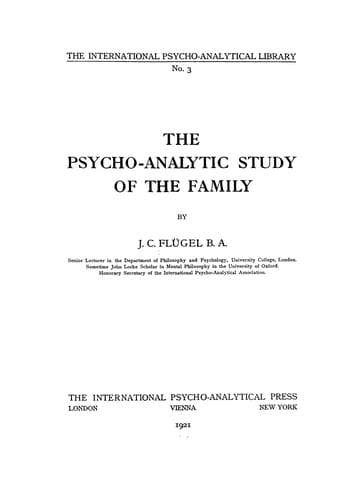
The psycho-analytic study of the familyFlugel, J. C. (John Carl)
Science
The psycho-analytic study of the family
Flugel, J. C. (John Carl)
Families; Marriage; Parent and child; Psychoanalysis
There are considerable differences, both individual and national, as
regards the relative importance of the father and the mother elements
respectively in the general attitude adopted towards the state, and
it would seem probable that these differences are apt to lead to, or
at least to be correlated with, political characteristics of very
great importance. Thus England is looked upon almost entirely as a
mother, the father-regarding aspects of an Englishman's feeling for his
country playing but a very minor part in the formation of his total
attitude; the same is in the main true of modern--as distinct from
prerevolutionary--France (though, as Ernest Jones[153] points out, the
term 'la patrie'--combining as it does a feminine form with a masculine
connotation--implies to some extent the co-operation of both elements),
while the colossal female statue of Liberty at the entrance to New
York would certainly seem to indicate that the land of freedom which
the traveller is approaching is to be regarded as an embodiment of the
matriarchal, rather than of the patriarchal, aspects of human society.
Germany, on the other hand, is habitually spoken of as the Fatherland;
while in Russia the Czar was regarded, to a unique extent perhaps among
modern nations, as the Father of his country. The tendency to blind
loyalty and obedience manifested in these latter countries compared,
until recently, most markedly with the relatively free and unconstrained
affection exhibited by the citizens of the former states towards their
native land, and suggests the existence of a fairly close correspondence,
on the one hand between the maternal view of the state and the development
of democratic institutions and individual independence, and on the other
hand between the paternal view and the development and retention of
autocracy and a relatively strict subordination of the individual to the
authority of the government and of its representatives.
It would be possible also perhaps to point to a general tendency towards a
similar association of the mother-regarding attitude with a trend towards
change, progress or instability, and of the father-regarding attitude
with a corresponding trend towards stability and conservatism; though the
extreme progressiveness, in certain respects, of modern Germany has shown
that any such tendency does not hold for all cases or for all aspects of
culture.
Public-domain text, read in full here on John Shaqi.
Reviews
Reviews
No reviews yet
Be the first to share your thoughts on this work.
Elsewhere in the archive
Join the Discussion
Join the discussion
Sign in to leave a comment or review.
Sign InorCreate an account