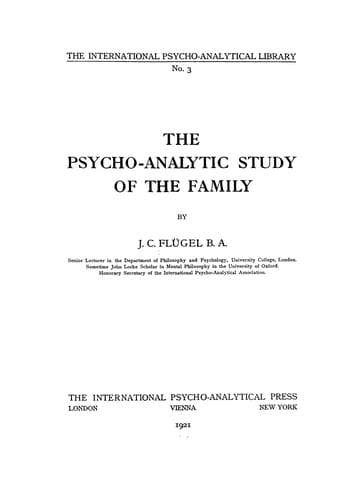
The psycho-analytic study of the familyFlugel, J. C. (John Carl)
Science
The psycho-analytic study of the family
Flugel, J. C. (John Carl)
Families; Marriage; Parent and child; Psychoanalysis
[Footnote 147: O. Rank, "Um Städte werben," _Zeitschrift für Ärztliche
Psychoanalyse_, 1914, II, 50. B. Dattner, "Die Stadt als Mutter,"
_Zeitschrift für Ärztliche Psychoanalyse_, 1914, II, 59.]
[Footnote 148: "War and Individual Psychology," _Sociological Review_,
1915, p. 1.]
[Footnote 149: "Das Inzestmotiv in Dichtung und Sage," 83.]
[Footnote 150: "Papers on Psycho-Analysis," 143.]
[Footnote 151: Ernest Jones, _loc. cit._]
[Footnote 152: Ernest Jones, _loc. cit._]
[Footnote 153: "War and Individual Psychology," _Sociological Review_,
1915, p. 10.]
[Footnote 154: "Das Inzestmotiv in Dichtung und Sage," 414 ff.]
[Footnote 155: Ernest Jones, _loc. cit._]
[Footnote 156: "Totem and Taboo," 70 ff.]
[Footnote 157: For a brief general account of projection _cp._ Bernard
Hart, "The Psychology of Insanity," 117 ff.]
[Footnote 158: A certain priestly king in West Africa may not even quit
his chair, in which he has to sleep sitting. Frazer, "Taboo and the Perils
of the Soul," 123.]
[Footnote 159: Frazer, _op. cit._, 124.]
[Footnote 160: Frazer, _op. cit._, 18.]
[Footnote 161: We may briefly mention here a few of the main lines along
which the evidence for the identification of regicide and parricide
proceeds:--
(1) The very person who performs the deed of murder is frequently the one
who succeeds to the throne; taking this in combination with the fact that
it is usually the son or some other near relative who is the recognised
successor, it is evident that there exists a natural tendency for the
murderer to belong to the murdered king's own family.
(2) The birth of a son is very frequently associated with the idea of
danger to the father. This danger would appear to be the principal motive
for the widespread custom of killing the king's son, which seems to be
regarded as, in many respects, an alternative to the killing of the king
himself (see Frazer, "The Dying God," Ch. VI, 160 ff.) _Cp._ the very
frequent legends (of which the story of Œdipus is one) in which a kingly
father, to avoid threatened danger to himself, exposes or otherwise
attempts to murder his young son. See Rank, "The Myth of the Birth of the
Hero."
(3) There exist many cases in legend, and some in actual fact, in which
the son fights with his father for the privileges of chieftainship; while
in at least one case (Frazer, "The Dying God," 190) the king is made to
abdicate as soon as his son is born.
(4) In the many quaint practices of the Carnival type, which, as Frazer
has shown ("The Dying God," 205 ff.), usually represent, in one at least
of their aspects, the murder of the king in the shape of the spirit of
vegetation, the death of the old monarch is usually followed, immediately
or after an interval, by general rejoicing at the coming to power of his
successor (_cp._ the well known phrase, "Le roi est mort, vive le roi")
showing that the idea of the superseding of an outworn potentate is a
prominent underlying feature of the whole type of ceremony.
Public-domain text, read in full here on John Shaqi.
Reviews
Reviews
No reviews yet
Be the first to share your thoughts on this work.
Elsewhere in the archive
Join the Discussion
Join the discussion
Sign in to leave a comment or review.
Sign InorCreate an account