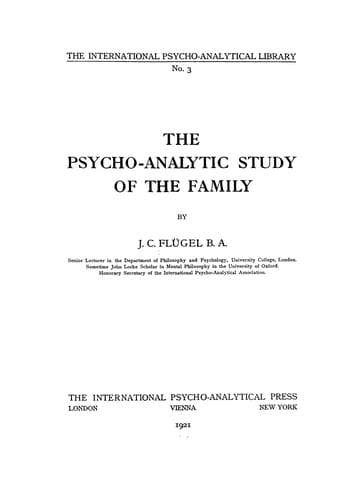
The psycho-analytic study of the familyFlugel, J. C. (John Carl)
Science
The psycho-analytic study of the family
Flugel, J. C. (John Carl)
Families; Marriage; Parent and child; Psychoanalysis
(5) Festivals of this kind, and indeed those connected with the succession
of kings generally, are usually associated with some kind of sexual orgy,
in which the relaxation of the usual prohibitions, especially those which
relate to incest, is often a prominent feature; this fact seems to point
to the existence of some connection between incest and succession to the
kingship, such as that which is manifested in the myth of Œdipus.
(6) This connection is indicated even more clearly by the widespread
custom of the new king taking over the wife of the king whom he has
succeeded, even if she should be his own step-mother, or in some cases
perhaps his real mother (See Frazer, "The Magic Art and the Evolution of
Kings," II, 283 ff., "The Dying God," 193 ff.). Where (as seems to have
happened not infrequently) this is combined with the murder, deposition
or defeat of the old king, we get both elements of the Œdipus complex in
intimate association, and openly expressed.
(7) Among the prohibitions and conditions to which a king is subject
during his tenure of office, not the least burdensome are those connected
with his sexual life. On the one hand his sexual activities are often
restricted, permitted only under certain circumstances and conditions or
even forbidden altogether; while on the other hand any failure or weakness
of sexual power may be made the reason for his deposition or execution. If
the sexual jealousy, which is such an important constituent of the Œdipus
complex, plays an active part in the attitude habitually adopted towards
kings (especially by those who are likely to become their successors),
such restrictions on the king's sexual activity or such a utilisation
of any sexual failing on his part as an excuse for his deposition or
execution are only what we might expect to find.
In bringing forward these arguments in favour of the operation of the
Œdipus complex in the treatment accorded to kings, we must not of course
shut our eyes to the co-operation of other important motives belonging to
the later and more conscious levels of the mind, such as that emphasised
by Frazer, according to whom the king is regarded as the embodiment of
natural fertility, so that, if he were to become old or enfeebled, Nature
(in virtue of the principles of homoeopathic magic) would suffer from a
corresponding weakness and produce less abundantly; this belief naturally
leading to the desire to kill the king while he is still in his prime,
lest in age or disease he should endanger the sustenance of the community.
Such a motive as this (and perhaps still others) may very well co-exist
with the motives connected with the Œdipus complex, in virtue of the
psychological mechanism of over-determination, just as--as Silberer, Rank,
and others have shown--many myths, legends and neurotic symptoms may give
direct or symbolic expression at the same time to two or more distinct
sets of tendencies.]
CHAPTER XIII
FAMILY INFLUENCES IN RELIGION
Public-domain text, read in full here on John Shaqi.
Reviews
Reviews
No reviews yet
Be the first to share your thoughts on this work.
Elsewhere in the archive
Join the Discussion
Join the discussion
Sign in to leave a comment or review.
Sign InorCreate an account