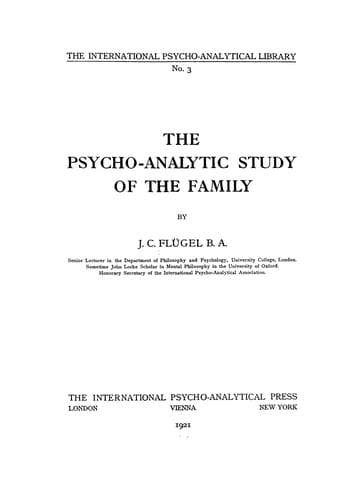
The psycho-analytic study of the familyFlugel, J. C. (John Carl)
Science
The psycho-analytic study of the family
Flugel, J. C. (John Carl)
Families; Marriage; Parent and child; Psychoanalysis
In primitive myths of this kind we see the hostile relations between
successive generations displayed crudely and nakedly, without any attempt
at disguise or concealment. In others, probably dating from a more
cultured epoch, there are signs of a mental conflict, the hostile actions
being no longer performed with the same singleness of purpose and freedom
from inhibition, but being accompanied by indications of a sense of
guilt, or of an ability to understand or sympathise with the opponent's
point of view. In the battle of the Titans against Zeus, some of the
former fought on the side of the gods (_i. e._ defended their parents) and
those who rebelled against the paternal power were in the end defeated
and punished (though the punishment itself may sometimes--by a piece of
over-determination--constitute a continuation of the rebellious deed, as
in the above-mentioned case of Atlas); Adam and Eve, on transgressing the
divine prohibition to eat of the tree of knowledge (_cp._ the forbidden
question motive, p. 104) are turned out of Eden; the builders of the Tower
of Babel (_cp._ the attempt to storm Heaven by Otos and Ephialtes in
Greek mythology) likewise meet with disaster; and in the noble story of
Prometheus, who stole the fire[187] from Heaven to benefit mankind, the
offender is brought into conflict with the father from the highest motives
and bears his punishment with a resignation and fortitude that places him
among the most splendid figures in Greek tragedy.
Christ himself is only one of the last of the long line of filial
insurgents, substituting as he does, to a considerable extent, the milder
rule of the Son for the harsher regime of the Judaic Father-God. In so
doing he surrenders his life, thus suffering the penalty which, in one
form or another, overtook his predecessors. In his case however, as in
theirs, the penalty itself is over-determined. Christ dies:--in the first
place, as a scapegoat, taking upon himself the guilt of his brothers and
hence becoming the saviour of mankind, who are by his sacrifice freed
from the consequences of their equal guilt[188]; secondly, as one who
suffers the talion punishment for the original sin of the son towards the
father, the guilt attaching to the death of the father being wiped out
by the death of the son; thirdly, by this very sacrifice manifesting his
divine nature and raising himself to a place alongside the father, thus
ultimately pointing the way to a reconciliation between father and son (a
reconciliation that is already hinted at in the story of Prometheus).
[Sidenote: Family influences in religious rites and practices]
[Sidenote: Baptism and Confirmation]
Public-domain text, read in full here on John Shaqi.
Reviews
Reviews
No reviews yet
Be the first to share your thoughts on this work.
Elsewhere in the archive
Join the Discussion
Join the discussion
Sign in to leave a comment or review.
Sign InorCreate an account