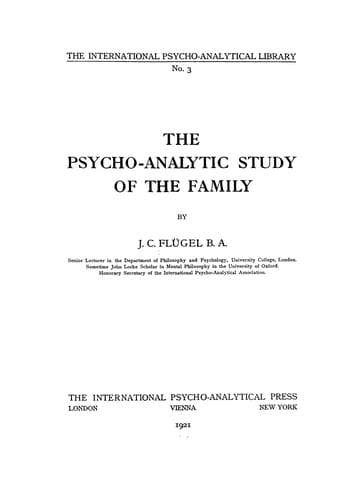
The psycho-analytic study of the familyFlugel, J. C. (John Carl)
Science
The psycho-analytic study of the family
Flugel, J. C. (John Carl)
Families; Marriage; Parent and child; Psychoanalysis
It is easy of course to point to the numerous evils that religion has
directly or indirectly brought about; conservatism, intolerance,
persistent opposition to the progress of scientific or unprejudiced
thought, the fostering of manifold delusions and absurdities, the
retention of vast masses of mankind in superstitious fear and ignorance
when they should have been acquiring confidence and knowledge. In spite
however of these and of the many other very serious charges that may be
brought against it, religion can claim to have played a very necessary and
beneficial rôle in the past history of culture. Sublimation is, as we have
seen, a process that works slowly and by finely graduated steps, so that
neither in the individual nor the race can we expect to see far-reaching
moral transformations rapidly and easily achieved. The feelings and
tendencies of the child in relation to the family environment are in
many of their aspects so primitive and crude and yet so powerful and
persistent, that we must welcome gladly any means of displacement that has
proved itself of value to the individual and to Society. It is for this
service, above all others, that we are indebted to religion in the past.
[Sidenote: The future of religion]
As regards the future, it is evident that the needs of humanity to which
religion has ministered will, in some sense at any rate, long continue
to exist. The backward pull of the tendencies of infancy and childhood,
forming, as they do, the foundation upon which all subsequent desires and
aspirations are built up; the closeness of the similarity between the
situation of the adult confronted with the vast and overwhelming power of
Nature and that of the child who helplessly depends upon his parents both
for happiness and life--these are influences which may well continue to
make religion in some form a permanent necessity.
Nevertheless it would appear that the future progress of human culture
will demand a very considerable modification and purification of most
existing religious forms. The study of the psychology of religion
is showing that these forms are, for the most part, based on crude
unconscious motives which have to be outgrown and superseded if
civilisation is to prosper and advance. In retaining and fostering these
forms we are in many cases playing into the hands, not of the higher, but
of the baser and more primitive aspects of our nature, aspects which, at
our present level of development, it is necessary indeed to understand,
but not to venerate or even to approve. Even in so far as the forms of
religion give expression not so much to the direct promptings of these
baser aspects as to the reactions we have formed against them, it must
be remembered that true moral advance lies in sublimation rather than
in repression and that so long as the human mind confines itself to the
purely negative task of opposing its own primitive tendencies, it will
never achieve either true emancipation or true progress[199].
Public-domain text, read in full here on John Shaqi.
Reviews
Reviews
No reviews yet
Be the first to share your thoughts on this work.
Elsewhere in the archive
Join the Discussion
Join the discussion
Sign in to leave a comment or review.
Sign InorCreate an account