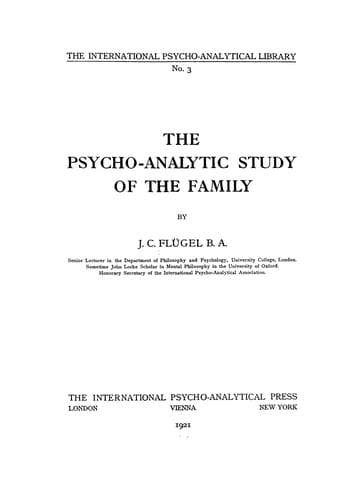
The psycho-analytic study of the familyFlugel, J. C. (John Carl)
Science
The psycho-analytic study of the family
Flugel, J. C. (John Carl)
Families; Marriage; Parent and child; Psychoanalysis
This process of identification is not however operative only with regard
to hatred. It may exert also a powerful influence upon the direction
of love and is often of special importance where parents definitely
select a favourite from among their children, this favourite child being
then invested with the love that was formerly directed to the favourite
parent[209]. For this reason too parents may often be desirous that their
children should adopt the profession, mode of life, beliefs or habits of
their (the childrens') grandparents[210].
[Sidenote: The effect of parent-child love on the attitude of parents to
each other]
In all cases where a parent resents the coming into being or the presence
of children, and especially in those where the resentment is based largely
upon jealousy, some degree of displeasure is apt to be directed upon
the other parent, who is regarded as responsible for the existence of
the unwelcome intruder or as transferring to him an undue proportion of
attention and affection. In this respect the situation recalls in the
parents mind the earlier one in which, in his own childhood, he resented
the love of his parents for each other, and in consequence of which
the love which he himself bore to one of his parents became converted
into, or was mixed with, hatred and contempt (_cp._ p. 110). Thus a
father may experience towards his wife something of those feelings of
outraged jealousy which he had formerly harboured towards his mother--a
resuscitation and transference of feelings of this kind being rendered
all the easier by the fact that his wife is very probably already to
some extent unconsciously identified with his mother, so that the whole
original situation is lived through again with the substitution of wife
for mother and of child (especially of course in the case of a boy) for
father.
[Sidenote: The Couvade]
It has recently been shown by Reik[211] that this last mentioned
factor of the resentment against the wife together with the previously
discussed jealousy and hatred of the child are capable of throwing a
very considerable amount of light upon certain customs practised amongst
primitive peoples upon the occasion of the birth of a child--customs the
origin and nature of which it appears at first sight very difficult to
understand. To these customs we may well devote a brief consideration
here, since they seem peculiarly adapted to bring out some of the most
important aspects of the unconscious feelings of parents toward their
offspring and--incidentally--toward one another. The customs in question
are generally comprehended under the single term Couvade and may be
divided, following Frazer, into two main groups:--
(1) the pre-natal or pseudo-maternal Couvade, which aims primarily and
ostensibly at a magical transference of the mother's labour pains on to
the person of the father, the father pretending to undergo what the mother
experiences in reality;
Public-domain text, read in full here on John Shaqi.
Reviews
Reviews
No reviews yet
Be the first to share your thoughts on this work.
Elsewhere in the archive
Join the Discussion
Join the discussion
Sign in to leave a comment or review.
Sign InorCreate an account