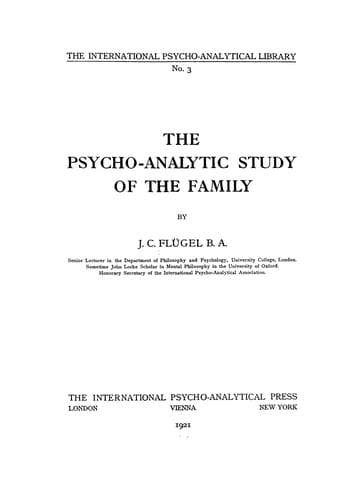
The psycho-analytic study of the familyFlugel, J. C. (John Carl)
Science
The psycho-analytic study of the family
Flugel, J. C. (John Carl)
Families; Marriage; Parent and child; Psychoanalysis
(2) the post-natal or dietetic Couvade, in which the father pretends to
be weak or ailing for a certain time after the birth of his child, during
which time he keeps to his bed and refrains from eating certain foods.
[Sidenote: The pre-natal Couvade as an expression of ambivalent feelings
towards the wife]
As regards the pre-natal Couvade, it is obvious that the occasion of
his wife's labour is one which is liable to arouse strong, and to some
extent conflicting, emotions in the father. The danger and distress
to which the mother is exposed naturally tend to arouse in the father
feelings of sympathy and anxiety together with a desire to help and to
alleviate the suffering to the best of his ability--an attitude which
finds expression in an attempt to transfer the pain according to the
principles of homoeopathic magic. At the same time the position of the
mother is such as to stimulate in the father any hostile and cruel wishes
he may entertain towards her, and, though such wishes will generally be
confined entirely or principally to the Unconscious, they will usually be
present in a greater or a less degree; since, besides any general cause of
hostility and any tendency to Sadism (both of which are probably at work
to some extent), there is liable to occur the more specific resentment
connected with the bringing into existence of a rival, who may usurp
much of the mother's care and affection which the father had hitherto
enjoyed alone. There is reason to suppose therefore that at certain levels
of the father's mind there is often present an actual enjoyment in the
contemplation of the mother's sufferings and even a wish that she may die.
In taking upon himself the mother's pains, the father is therefore, at one
and the same time, doing his best to help the mother, subjecting himself
to a talion punishment for desiring the mother to feel pain, and placing
himself in a position more thoroughly to express and realise her suffering.
[Sidenote: The belief in demons]
A similar attitude is indicated by the beliefs and practices with regard
to demons which are frequently found associated with the Couvade. Demons
are, from the psychological point of view, merely projections of thoughts
and tendencies of the unconscious mind, and the demons who are supposed
to be inflicting pain upon the mother are therefore an expression of the
unconscious desire to inflict such pain. This desire manifests itself also
in not a few of the measures which are taken to drive away the demons,
measures which, though ostensibly undertaken for the benefit of the mother
are in reality calculated to cause her fright, pain or discomfort, such as
shooting, shouting, lighting fires in her proximity, playing with swords
or even beating her.
[Sidenote: The post-natal Couvade results principally from hostile
feelings towards the child]
Public-domain text, read in full here on John Shaqi.
Reviews
Reviews
No reviews yet
Be the first to share your thoughts on this work.
Elsewhere in the archive
Join the Discussion
Join the discussion
Sign in to leave a comment or review.
Sign InorCreate an account