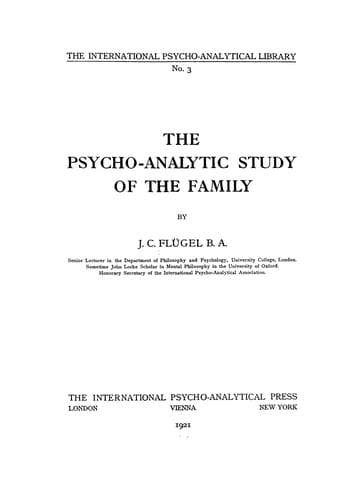
The psycho-analytic study of the familyFlugel, J. C. (John Carl)
Science
The psycho-analytic study of the family
Flugel, J. C. (John Carl)
Families; Marriage; Parent and child; Psychoanalysis
While the pre-natal Couvade is thus principally the manifestation of
repressed hostility towards the mother, the post-natal Couvade would seem
to arise chiefly as the result of a similar attitude towards the child.
This is shown by the fact that the practices associated with this aspect
of the Couvade are held to be necessary for, or at least conducive to, the
life and health of the newly born infant, who is regarded as peculiarly
liable to be affected by injudicious behaviour on the part of the father;
it is also shown by the fact that the father is often held responsible for
any evil that may befall the child during the first days of its existence;
thus indicating an appreciation of the real unconscious tendency of the
father to do the child some harm. As regards the prohibition of certain
foods, it would seem that this is ultimately traceable to a repression of
the tendency to kill and eat the child (and through him the grandfather
whom he represents) a tendency which we considered in the last chapter,
and one to which most, if not all, taboos on foods would appear in
the last resort very largely to depend. The father's imaginary illness
is also to some extent influenced by his hostile feelings against the
mother:--negatively, in that by keeping to his bed he is prevented from
doing her harm; positively, in that by compelling her to attend on him in
his pretended helplessness, he forces her to work at a time when rest and
freedom from trouble would have been more welcome.
[Sidenote: The Couvade as an assertion of the father's rights]
Certain other students of the Couvade, such as Bachofen, are probably
to some extent right too in maintaining that the practice represents an
assertion by the father of his rights and privileges, being connected
thus with the transition from mother-descent to father-descent. Certain
it is that through the practice the father emphasises his share of the
parenthood and thus effectually prevents any tendency to regard the mother
as the sole, or even as the chief, producer and guardian of the child. In
so doing, he also, we may suspect, endeavours to produce a compensation
for the lack of attention from which he might otherwise suffer at this
time, owing to the fact that the mother's share of parenthood is at the
moment of birth by nature so much more prominent than that of the father.
[Sidenote: The corresponding attitude in modern life]
Public-domain text, read in full here on John Shaqi.
Reviews
Reviews
No reviews yet
Be the first to share your thoughts on this work.
Elsewhere in the archive
Join the Discussion
Join the discussion
Sign in to leave a comment or review.
Sign InorCreate an account